-
Chinese (Simplified)
-
English
-
German
-
Korean
-
Spanish
Chinese (Simplified)
English
German
Korean
Spanish
Sign up for an account to enjoy easy online shopping and instant order tracking.
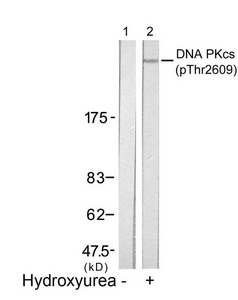
The antibody against PRKDC was raised in rabbit using the Peptide sequence around phosphorylation site of threonine 2609 (V-E-T(p)-Q-A) derived from Human DNA-PK. as the immunogen. Antibodies were produced by immunizing rabbits with synthetic phosphopeptide and KLH conjugates. Antibodies were purified by affinity-chromatography using epitope-specific phosphopeptide. Non-phospho specific antibodies were removed by chromatogramphy usi This antibody has been validated on ELISA, WB.
$360.00
| Cat.No | ADC-43709A | Clonality | Polyclonal |
|---|---|---|---|
| Host Species | Rabbit | Target Name | PRKDC |
| Target Synonyms | complementing 1 antibody; Hyperradiosensitivity complementing 1, mouse | Form | Liquid |
| Species Reactivity | Human | Storage Buffer | PH 7.4, 0.02% sodium azide and 50% glycerol., 150mM NaCl, Supplied at 1.0mg/mL in phosphate buffered saline (without Mg2+ and Ca2+) |
| Application | ELISA, WB | Storage | Upon receipt |
| Immunogen Description | Peptide sequence around phosphorylation site of threonine 2609 (V-E-T(p)-Q-A) derived from Human DNA-PK. | Target Species | Human |
|---|---|---|---|
| Immunogen Sequence | Complete sequences for the immunogen, target protein, and peptides are available upon request. | Uniprot ID | P78527 |
Uniprot Id
P78527
Target Species
Human
Target Name
PRKDC
Target Full Name
DNA-dependent protein kinase catalytic subunit
Target Function
Serine/threonine-protein kinase that acts as a molecular sensor for DNA damage. Involved in DNA non-homologous end joining (NHEJ) required for double-strand break (DSB) repair and V(D)J recombination. Must be bound to DNA to express its catalytic properties. Promotes processing of hairpin DNA structures in V(D)J recombination by activation of the hairpin endonuclease artemis (DCLRE1C). Recruited by XRCC5 and XRCC6 to DNA ends and is required to (1) protect and align broken ends of DNA, thereby preventing their degradation, (2) and sequester the DSB for repair by NHEJ. Act as a scaffold protein to aid the localization of DNA repair proteins to the site of damage. The assembly of the DNA-PK complex at DNA ends is also required for the NHEJ ligation step. Found at the ends of chromosomes, suggesting a further role in the maintenance of telomeric stability and the prevention of chromosomal end fusion. Also involved in modulation of transcription. As part of the DNA-PK complex, involved in the early steps of ribosome assembly by promoting the processing of precursor rRNA into mature 18S rRNA in the small-subunit processome. Binding to U3 small nucleolar RNA, recruits PRKDC and XRCC5/Ku86 to the small-subunit processome. Recognizes the substrate consensus sequence [ST]-Q. Phosphorylates 'Ser-139' of histone variant H2AX, thereby regulating DNA damage response mechanism. Phosphorylates DCLRE1C, c-Abl/ABL1, histone H1, HSPCA, c-jun/JUN, p53/TP53, PARP1, POU2F1, DHX9, FH, SRF, NHEJ1/XLF, XRCC1, XRCC4, XRCC5, XRCC6, WRN, MYC and RFA2. Can phosphorylate C1D not only in the presence of linear DNA but also in the presence of supercoiled DNA. Ability to phosphorylate p53/TP53 in the presence of supercoiled DNA is dependent on C1D. Contributes to the determination of the circadian period length by antagonizing phosphorylation of CRY1 'Ser-588' and increasing CRY1 protein stability, most likely through an indirect mechanism. Plays a role in the regulation of DNA virus-mediated innate immune response by assembling into the HDP-RNP complex, a complex that serves as a platform for IRF3 phosphorylation and subsequent innate immune response activation through the cGAS-STING pathway.
Target Involvement
Immunodeficiency 26 with or without neurologic abnormalities (IMD26)
Target Subcellular Location
Nucleus. Nucleus, nucleolus.
Target Protein Families
PI3/PI4-kinase family
Target Synonyms
DNA dependent protein kinase catalytic subunit; DNA PK catalytic subunit; DNA-dependent protein kinase catalytic subunit; DNA-PK catalytic subunit; DNA-PKcs; DNAPK; DNAPK catalytic subunit; DNPK 1; DNPK1; Hyper radiosensitivity of murine scid mutation, complementing 1; Hyperradiosensitivity complementing 1, mouse, homolog of 1; HYRC 1; HYRC; HYRC1; IMD26; p350; p460; PKRDC; PRKDC; PRKDC_HUMAN; Protein Kinase DNA Activated Catalytic Polypeptide; XRCC 7; XRCC7
Target Background
This gene encodes the catalytic subunit of the DNA-dependent protein kinase (DNA-PK). It functions with the Ku70/Ku80 heterodimer protein in DNA double strand break repair and recombination. The protein encoded is a member of the PI3/PI4-kinase family.
Notification