-
Chinese (Simplified)
-
English
-
German
-
Korean
-
Spanish

Chinese (Simplified)
English
German
Korean
Spanish
Sign up for an account to enjoy easy online shopping and instant order tracking.
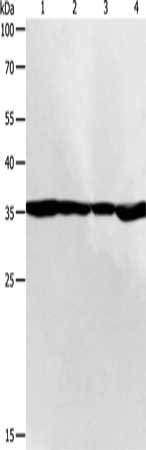
The antibody against PSMD14 was raised in rabbit using the Fusion protein of Human PSMD14 as the immunogen. This antibody exists as a non-conjugated isotype IgG, Antigen affinity purified. This antibody has been validated on ELISA, WB, IHC.
$299.00
| Cat.No | ADC-31438A | Clonality | Polyclonal |
|---|---|---|---|
| Host Species | Rabbit | Target Name | PSMD14 |
| Target Synonyms | 14 antibody; Proteasome 26S subunit non ATPase 14 antibody; PSDE_HUMAN antibody; Psmd14 antibody; RPN11 antibody; Testis tissue sperm binding protein Li 69n antibody, homolog of antibody; POH1 antibody; Proteasome (prosome, macropain) 26S subunit, non-ATPase, yeast | Form | Liquid |
| Species Reactivity | Human, Mouse | Isotype | IgG |
| Storage Buffer | 0.05% NaN3, 40% Glycerol., pH7.4 PBS | Purification Method | Antigen affinity purified |
| Conjugate | Non-conjugated | Application | ELISA, IHC, WB |
| Storage | Upon receipt |
| Immunogen Description | Fusion protein of Human PSMD14 | Target Species | Human |
|---|---|---|---|
| Immunogen Sequence | Complete sequences for the immunogen, target protein, and peptides are available upon request. | Uniprot ID | O00487 |
Uniprot Id
O00487
Target Species
Human
Target Name
PSMD14
Target Full Name
26S proteasome non-ATPase regulatory subunit 14
Target Function
Component of the 26S proteasome, a multiprotein complex involved in the ATP-dependent degradation of ubiquitinated proteins. This complex plays a key role in the maintenance of protein homeostasis by removing misfolded or damaged proteins, which could impair cellular functions, and by removing proteins whose functions are no longer required. Therefore, the proteasome participates in numerous cellular processes, including cell cycle progression, apoptosis, or DNA damage repair. The PSMD14 subunit is a metalloprotease that specifically cleaves 'Lys-63'-linked polyubiquitin chains within the complex. Plays a role in response to double-strand breaks (DSBs): acts as a regulator of non-homologous end joining (NHEJ) by cleaving 'Lys-63'-linked polyubiquitin, thereby promoting retention of JMJD2A/KDM4A on chromatin and restricting TP53BP1 accumulation. Also involved in homologous recombination repair by promoting RAD51 loading.
Target Protein Families
Peptidase M67A family, PSMD14 subfamily
Target Tissue Specificity
Widely expressed. Highest levels in heart and skeletal muscle.
Target Research Area
Cell Biology
Target Synonyms
26S proteasome non-ATPase regulatory subunit 14; 26S proteasome regulatory subunit rpn11; 26S proteasome-associated PAD1 homolog 1; 26S proteasome-associated PAD1 homolog; PAD1; PAD1, yeast, homolog of; POH1; Proteasome (prosome, macropain) 26S subunit, non-ATPase, 14; Proteasome 26S subunit non ATPase 14; PSDE_HUMAN; Psmd14; RPN11; Testis tissue sperm binding protein Li 69n
Target Background
This gene encodes a component of the 26S proteasome. The 26S proteasome is a large multiprotein complex that catalyzes the degradation of ubiquitinated intracellular proteins. The encoded protein is a component of the 19S regulatory cap complex of the 26S proteasome and mediates substrate deubiquitination. A pseudogene of this gene is also located on the long arm of chromosome 2.
Notification