-
Chinese (Simplified)
-
English
-
German
-
Korean
-
Spanish
Chinese (Simplified)
English
German
Korean
Spanish
Sign up for an account to enjoy easy online shopping and instant order tracking.
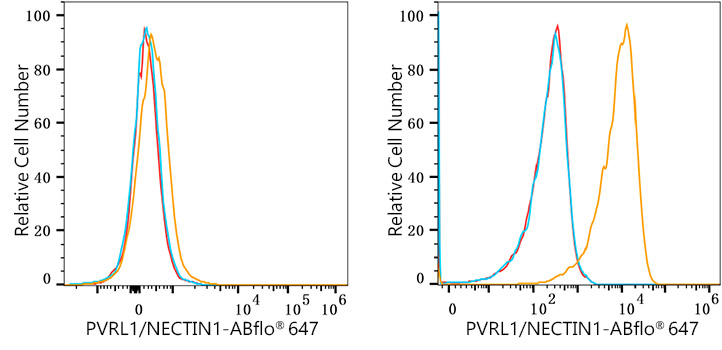
The antibody against PVRL1/NECTIN1 was raised in Rabbit using the recombinant fusion protein containing a sequence corresponding to amino acids 1-334 of human PVRL1/NECTIN1 (NP_002846.3) as the immunogen. The monoclonal antibody exists as a isotype IgG, by affinity purification. This antibody has been validated on FC.
| Cat.No | ADA-15628A | Clonality | Monoclonal |
|---|---|---|---|
| Host Species | Rabbit | Target Name | PVRL1/NECTIN1 |
| Target Synonyms | ED4; PRR; HIgR; HV1S; HVEC; OFC7; PRR1; PVRR; CD111; PVRL1; PVRR1; SK-12; CLPED1; nectin-1; PVRL1/NECTIN1 | Form | Liquid |
| Species Reactivity | Human | Isotype | IgG |
| Storage Buffer | 50% Glycerol, 0.05% BSA, PBS with 0.05% proclin300, pH7.3. | Purification Method | Affinity purification |
| Application | FC |
| Immunogen Description | Recombinant fusion protein containing a sequence corresponding to amino acids 1-334 of human PVRL1/NECTIN1 (NP_002846.3). | Target Species | Human |
|---|---|---|---|
| Uniprot ID | Q15223 | Immunogen Sequence |
Uniprot Id
Q15223
Target Species
Human
Target Name
NECTIN1
Target Full Name
Nectin-1
Target Function
Promotes cell-cell contacts by forming homophilic or heterophilic trans-dimers. Heterophilic interactions have been detected between NECTIN1 and NECTIN3 and between NECTIN1 and NECTIN4. Has some neurite outgrowth-promoting activity.; (Microbial infection) Acts as a receptor for herpes simplex virus 1/HHV-1, herpes simplex virus 2/HHV-2, and pseudorabies virus/PRV.
Target Involvement
Ectodermal dysplasia, Margarita Island type (EDMI); Non-syndromic orofacial cleft 7 (OFC7)
Target Subcellular Location
[Isoform Alpha]: Cell membrane; Single-pass type I membrane protein. Cell junction, synapse, presynaptic cell membrane.; [Isoform Delta]: Cell membrane; Single-pass type I membrane protein.; [Isoform Gamma]: Secreted.
Target Protein Families
Nectin family
Target Synonyms
CD111; CD111 antigen; CLPED1; ectodermal dysplasia 4 (Margarita Island type); ED4; Herpes virus entry mediator C; Herpesvirus entry mediator C; Herpesvirus Ig like receptor; Herpesvirus Ig-like receptor; HIgR; HveC; MGC142031; Nectin 1; Nectin-1; OFC7; OROFACIAL CLEFT 7; OTTHUMP00000232093; OTTHUMP00000232094; OTTHUMP00000232095; Poliovirus receptor related protein 1; poliovirus receptor-like 1; Poliovirus receptor-related protein 1; PRR; PRR1; PVRL 1; PVRL1; PVRL1_HUMAN; PVRR; PVRR1; SK-12
Target Background
This gene encodes an adhesion protein that plays a role in the organization of adherens junctions and tight junctions in epithelial and endothelial cells. The protein is a calcium(2+)-independent cell-cell adhesion molecule that belongs to the immunoglobulin superfamily and has 3 extracellular immunoglobulin-like loops, a single transmembrane domain (in some isoforms), and a cytoplasmic region. This protein acts as a receptor for glycoprotein D (gD) of herpes simplex viruses 1 and 2 (HSV-1, HSV-2), and pseudorabies virus (PRV) and mediates viral entry into epithelial and neuronal cells. Mutations in this gene cause cleft lip and palate/ectodermal dysplasia 1 syndrome (CLPED1) as well as non-syndromic cleft lip with or without cleft palate (CL/P). Alternative splicing results in multiple transcript variants encoding proteins with distinct C-termini.
Notification