-
Chinese (Simplified)
-
English
-
German
-
Korean
-
Spanish
Chinese (Simplified)
English
German
Korean
Spanish
Sign up for an account to enjoy easy online shopping and instant order tracking.
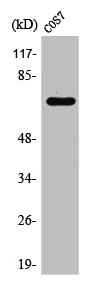
The antibody against RACGAP1 was raised in rabbit using the Synthesized peptide derived from Human Rac GAP1 around the non-phosphorylation site of S387. as the immunogen. This antibody exists as a non-conjugated isotype IgG. The antibody was affinity-purified from rabbit antiserum by affinity-chromatography using epitope-specific immunogen. This antibody has been validated on WB, IHC, IF, ELISA.
$167.00
| Cat.No | ADC-37757A | Clonality | Polyclonal |
|---|---|---|---|
| Host Species | Rabbit | Target Name | RACGAP1 |
| Form | Liquid | Species Reactivity | Human, Mouse, Rat, Monkey |
| Isotype | IgG | Storage Buffer | 0.5% BSA and 0.02% sodium azide., Liquid in PBS containing 50% glycerol |
| Purification Method | The antibody was affinity-purified from rabbit antiserum by affinity-chromatography using epitope-specific immunogen. | Conjugate | Non-conjugated |
| Application | ELISA, IF, IHC, WB | Storage | Upon receipt |
| Immunogen Description | Synthesized peptide derived from Human Rac GAP1 around the non-phosphorylation site of S387. | Target Species | Human |
|---|---|---|---|
| Immunogen Sequence | Complete sequences for the immunogen, target protein, and peptides are available upon request. | Uniprot ID | Q9H0H5 |
Uniprot Id
Q9H0H5
Target Species
Human
Target Name
RACGAP1
Target Full Name
Rac GTPase-activating protein 1
Target Function
Component of the centralspindlin complex that serves as a microtubule-dependent and Rho-mediated signaling required for the myosin contractile ring formation during the cell cycle cytokinesis. Required for proper attachment of the midbody to the cell membrane during cytokinesis. Plays key roles in controlling cell growth and differentiation of hematopoietic cells through mechanisms other than regulating Rac GTPase activity. Also involved in the regulation of growth-related processes in adipocytes and myoblasts. May be involved in regulating spermatogenesis and in the RACGAP1 pathway in neuronal proliferation. Shows strong GAP (GTPase activation) activity towards CDC42 and RAC1 and less towards RHOA. Essential for the early stages of embryogenesis. May play a role in regulating cortical activity through RHOA during cytokinesis. May participate in the regulation of sulfate transport in male germ cells.
Target Subcellular Location
Nucleus. Cytoplasm. Cytoplasm, cytoskeleton, spindle. Cytoplasmic vesicle, secretory vesicle, acrosome. Cleavage furrow. Midbody, Midbody ring. Cell membrane; Peripheral membrane protein; Cytoplasmic side.
Target Tissue Specificity
Highly expressed in testis, thymus and placenta. Expressed at lower levels in spleen and peripheral blood lymphocytes. In testis, expression is restricted to germ cells with the highest levels of expression found in spermatocytes. Expression is regulated
Target Synonyms
CYK4; GAP; Gap1; GTPase activating protein; HsCYK-4; ID GAP; KIAA1478; Male germ cell RacGap; MgcRacGAP; Protein CYK4 homolg; Protein CYK4 homolog; Rac GTPase activating protein 1; Rac GTPase-activating protein 1; RACGAP 1; Racgap1; RGAP1_HUMAN
Target Background
This gene encodes a GTPase-activating protein (GAP) that is a compoment of the centralspindlin complex. This protein binds activated forms of Rho GTPases and stimulates GTP hydrolysis, which results in negative regulation of Rho-mediated signals. This protein plays a regulatory role in cytokinesis, cell growth, and differentiation. Alternatively spliced transcript variants have been found for this gene. There is a pseudogene for this gene on chromosome 12.
Notification