-
Chinese (Simplified)
-
English
-
German
-
Korean
-
Spanish
Chinese (Simplified)
English
German
Korean
Spanish
Sign up for an account to enjoy easy online shopping and instant order tracking.
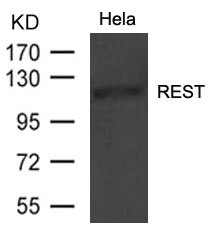
The antibody against REST was raised in rabbit using the Peptide sequence around aa.873~877(R-E-E-A-S) derived from Human REST. as the immunogen. Antibodies were produced by immunizing rabbits with synthetic peptide and KLH conjugates. Antibodies were purified by affinity-chromatography using epitope-specific peptide. This antibody has been validated on ELISA, WB.
$297.00
| Cat.No | ADC-43198A | Clonality | Polyclonal |
|---|---|---|---|
| Host Species | Rabbit | Target Name | REST |
| Form | Liquid | Species Reactivity | Human |
| Storage Buffer | PH 7.4, 0.02% sodium azide and 50% glycerol., 150mM NaCl, Supplied at 1.0mg/mL in phosphate buffered saline (without Mg2+ and Ca2+) | Purification Method | Antibodies were produced by immunizing rabbits with synthetic peptide and KLH conjugates. Antibodies were purified by affinity-chromatography using epitope-specific peptide. |
| Application | ELISA, WB | Storage | Upon receipt |
| Immunogen Description | Peptide sequence around aa.873~877(R-E-E-A-S) derived from Human REST. | Target Species | Human |
|---|---|---|---|
| Immunogen Sequence | Complete sequences for the immunogen, target protein, and peptides are available upon request. | Uniprot ID | Q13127 |
Uniprot Id
Q13127
Target Species
Human
Target Name
REST
Target Full Name
RE1-silencing transcription factor
Target Function
Transcriptional repressor which binds neuron-restrictive silencer element (NRSE) and represses neuronal gene transcription in non-neuronal cells. Restricts the expression of neuronal genes by associating with two distinct corepressors, SIN3A and RCOR1, which in turn recruit histone deacetylase to the promoters of REST-regulated genes. Mediates repression by recruiting the BHC complex at RE1/NRSE sites which acts by deacetylating and demethylating specific sites on histones, thereby acting as a chromatin modifier. Transcriptional repression by REST-CDYL via the recruitment of histone methyltransferase EHMT2 may be important in transformation suppression. Represses the expression of SRRM4 in non-neural cells to prevent the activation of neural-specific splicing events and to prevent production of REST isoform 3. Repressor activity may be inhibited by forming heterodimers with isoform 3, thereby preventing binding to NRSE or binding to corepressors and leading to derepression of target genes. Also maintains repression of neuronal genes in neural stem cells, and allows transcription and differentiation into neurons by dissociation from RE1/NRSE sites of target genes. Thereby is involved in maintaining the quiescent state of adult neural stem cells and preventing premature differentiation into mature neurons. Plays a role in the developmental switch in synaptic NMDA receptor composition during postnatal development, by repressing GRIN2B expression and thereby altering NMDA receptor properties from containing primarily GRIN2B to primarily GRIN2A subunits. Acts as a regulator of osteoblast differentiation. Key repressor of gene expression in hypoxia; represses genes in hypoxia by direct binding to an RE1/NRSE site on their promoter regions. May also function in stress resistance in the brain during aging; possibly by regulating expression of genes involved in cell death and in the stress response. Repressor of gene expression in the hippocampus after ischemia by directly binding to RE1/NRSE sites and recruiting SIN3A and RCOR1 to promoters of target genes, thereby promoting changes in chromatin modifications and ischemia-induced cell death. After ischemia, might play a role in repression of miR-132 expression in hippocampal neurons, thereby leading to neuronal cell death. Negatively regulates the expression of SRRM3 in breast cancer cell lines.; Binds to the 3' region of the neuron-restrictive silencer element (NRSE), with lower affinity than full-length REST isoform 1. Exhibits weaker repressor activity compared to isoform 1. May negatively regulate the repressor activity of isoform 1 by binding to isoform 1, thereby preventing its binding to NRSE and leading to derepression of target genes. However, in another study, does not appear to be implicated in repressor activity of a NRSE motif-containing reporter construct nor in inhibitory activity on the isoform 1 transcriptional repressor activity. Post-transcriptional inactivation of REST by SRRM4-dependent alternative splicing into isoform 3 is required in mechanosensory hair cells in the inner ear for derepression of neuronal genes and hearing.
Target Involvement
Wilms tumor 6 (WT6); Fibromatosis, gingival, 5 (GINGF5)
Target Subcellular Location
Nucleus. Cytoplasm.; [Isoform 2]: Cytoplasm.; [Isoform 3]: Nucleus.; [Isoform 4]: Cytoplasm.
Target Tissue Specificity
Expressed in neurons of the prefrontal cortex, in hippocampal pyramidal neurons, dentate gyrus granule neurons and cerebellar Purkinje and granule neurons (at protein level). Expressed in dopaminergic neurons of the substantia nigra (at protein level). Ex
Target Synonyms
Neural Restrictive Silencer Factor; Neural-restrictive silencer factor; Neuron Restrictive Silencer Factor; NRSF; RE1 silencing transcription factor; RE1-silencing transcription factor; Repressor binding to the X2 box; rest; REST protein; REST_HUMAN; X2 box repressor; XBR
Target Background
This gene was initially identified as a transcriptional repressor that represses neuronal genes in non-neuronal tissues. However, depending on the cellular context, this gene can act as either an oncogene or a tumor suppressor. The encoded protein is a member of the Kruppel-type zinc finger transcription factor family. It represses transcription by binding a DNA sequence element called the neuron-restrictive silencer element. The protein is also found in undifferentiated neuronal progenitor cells and it is thought that this repressor may act as a master negative regulator of neurogenesis. Alternatively spliced transcript variants have been described.
Notification