-
Chinese (Simplified)
-
English
-
German
-
Korean
-
Spanish
Chinese (Simplified)
English
German
Korean
Spanish
Sign up for an account to enjoy easy online shopping and instant order tracking.
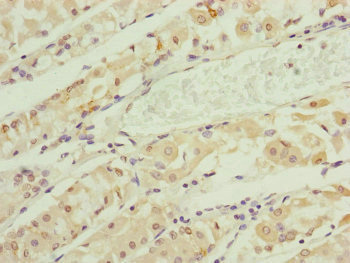
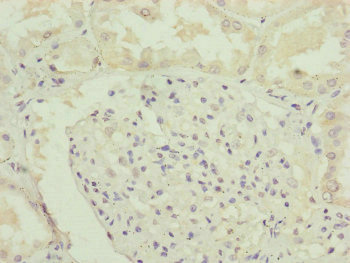
The antibody against RNF135 was raised in rabbit using the Recombinant Human E3 ubiquitin-protein ligase RNF135 protein (339-432AA) as the immunogen. This antibody exists as a non-conjugated isotype IgG, Antigen affinity purified. This antibody has been validated on ELISA, WB, IHC.
$299.00
| Cat.No | ADC-16596A | Clonality | Polyclonal |
|---|---|---|---|
| Host Species | Rabbit | Target Name | RNF135 |
| Form | Liquid | Species Reactivity | Human |
| Isotype | IgG | Storage Buffer | 50% Glycerol, PBS with 0.02% sodium azide, pH7.3. |
| Purification Method | Antigen affinity purified | Conjugate | Non-conjugated |
| Application | ELISA, IHC, WB | Storage | Upon receipt |
| Immunogen Description | Recombinant Human E3 ubiquitin-protein ligase RNF135 protein (339-432AA) | Target Species | Human |
|---|---|---|---|
| Immunogen Sequence | Complete sequences for the immunogen, target protein, and peptides are available upon request. | Uniprot ID | Q8IUD6 |
Uniprot Id
Q8IUD6
Target Species
Human
Target Name
RNF135
Target Full Name
E3 ubiquitin-protein ligase RNF135
Target Function
E2-dependent E3 ubiquitin-protein ligase that functions as a RIG-I/DDX58 coreceptor in the sensing of viral RNAs in cell cytoplasm and the activation of the antiviral innate immune response. Together with the UBE2D3, UBE2N and UB2V1 E2 ligases, catalyzes the 'Lys-63'-linked polyubiquitination of RIG-I/DDX58 oligomerized on viral RNAs, an essential step in the activation of the RIG-I signaling pathway. Through a ubiquitin-independent parallel mechanism, which consists in bridging RIG-I/DDX58 filaments forming on longer viral RNAs, further activates the RIG-I signaling pathway. This second mechanism that synergizes with the ubiquitin-dependent one would thereby allow an RNA length-dependent regulation of the RIG-I signaling pathway (Probable). Associated with the E2 ligase UBE2N, also constitutively synthesizes unanchored 'Lys-63'-linked polyubiquitin chains that may also activate the RIG-I signaling pathway.
Target Involvement
Macrocephaly, macrosomia, facial dysmorphism syndrome (MMFD)
Target Subcellular Location
Cytoplasm. Cytoplasm, Stress granule.
Target Tissue Specificity
Expressed in skeletal muscle, spleen, kidney, placenta, prostate, stomach, thyroid and tongue. Also weakly expressed in heart, thymus, liver and lung.
Target Synonyms
E3 ubiquitin-protein ligase RNF135; L13; MGC13061; MMFD; REUL; RIG-I E3 ubiquitin ligase; RING finger protein 135; Riplet; RN135_HUMAN; Rnf135
Target Background
The protein encoded by this gene contains a RING finger domain, a motif present in a variety of functionally distinct proteins and known to be involved in protein-protein and protein-DNA interactions. This gene is located in a chromosomal region known to be frequently deleted in patients with neurofibromatosis. Alternatively spliced transcript variants encoding distinct isoforms have been reported.
Notification