-
Chinese (Simplified)
-
English
-
German
-
Korean
-
Spanish
Chinese (Simplified)
English
German
Korean
Spanish
Sign up for an account to enjoy easy online shopping and instant order tracking.
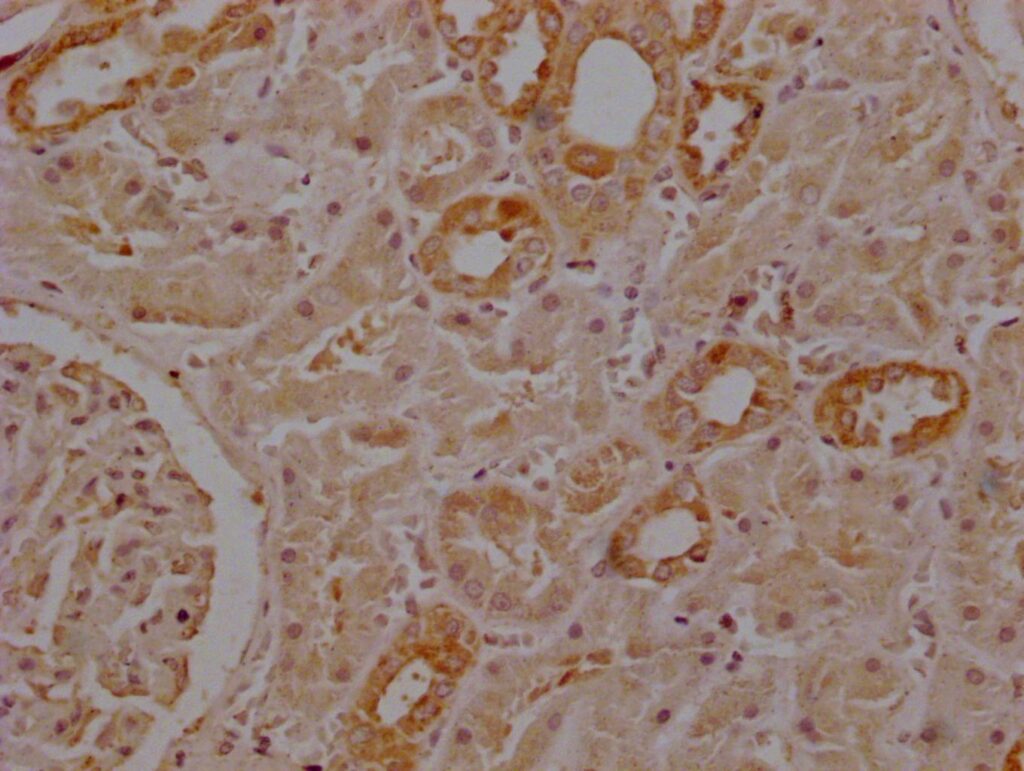
The antibody against SELENOP was raised in rabbit using the Recombinant Human Selenoprotein P protein (20-381AA) as the immunogen. This antibody exists as a non-conjugated isotype IgG, purified by protein G with a purity greater than 95%. This antibody has been validated on ELISA, WB, IHC.
$299.00
| Cat.No | ADC-49437A | Clonality | Polyclonal |
|---|---|---|---|
| Host Species | Rabbit | Target Name | SELENOP |
| Target Synonyms | Selenoprotein P antibody; Selenoprotein P plasma 1 antibody; Selp antibody; SeP antibody; Sepp1 antibody; SEPP1_HUMAN antibody | Form | Liquid |
| Species Reactivity | Human, Mouse | Isotype | IgG |
| Storage Buffer | 0.01M PBS, 0.03% Proclin 300; Constituents: 50% Glycerol, PH 7.4 | Purification Method | >95%, Protein G purified |
| Conjugate | Non-conjugated | Application | ELISA, IHC, WB |
| Storage | Upon receipt |
| Immunogen Description | Recombinant Human Selenoprotein P protein (20-381AA) | Target Species | Human |
|---|---|---|---|
| Immunogen Sequence | Complete sequences for the immunogen, target protein, and peptides are available upon request. | Uniprot ID | P49908 |
Uniprot Id
P49908
Target Species
Human
Target Name
SELENOP
Target Full Name
Selenoprotein P
Target Function
Might be responsible for some of the extracellular antioxidant defense properties of selenium or might be involved in the transport of selenium. May supply selenium to tissues such as brain and testis.
Target Subcellular Location
Secreted.
Target Protein Families
Selenoprotein P family
Target Tissue Specificity
Made in the liver and heart and secreted into the plasma. It is also found in the kidney.
Target Research Area
Others
Target Synonyms
Selenoprotein P; Selenoprotein P plasma 1; Selp; SeP; Sepp1; SEPP1_HUMAN
Target Background
This gene encodes a selenoprotein that is predominantly expressed in the liver and secreted into the plasma. This selenoprotein is unique in that it contains multiple selenocysteine (Sec) residues per polypeptide (10 in human), and accounts for most of the selenium in plasma. It has been implicated as an extracellular antioxidant, and in the transport of selenium to extra-hepatic tissues via apolipoprotein E receptor-2 (apoER2). Mice lacking this gene exhibit neurological dysfunction, suggesting its importance in normal brain function. Sec is encoded by the UGA codon, which normally signals translation termination. The 3' UTRs of selenoprotein mRNAs contain a conserved stem-loop structure, designated the Sec insertion sequence (SECIS) element, that is necessary for the recognition of UGA as a Sec codon, rather than as a stop signal. The mRNA for this selenoprotein contains two SECIS elements. The use of alternative polyadenylation sites, one located in between the two SECIS elements, results in two populations of mRNAs containing either both (predominant) or just the upstream SECIS element (PMID:27881738). Alternatively spliced transcript variants have also been found for this gene.
Notification