-
Chinese (Simplified)
-
English
-
German
-
Korean
-
Spanish
Chinese (Simplified)
English
German
Korean
Spanish
Sign up for an account to enjoy easy online shopping and instant order tracking.
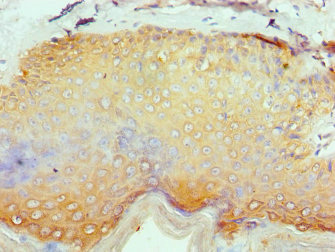
The antibody against SERPINB1 was raised in rabbit using the Recombinant Human Leukocyte elastase inhibitor protein (100-379AA) as the immunogen. This antibody exists as a non-conjugated isotype IgG, Antigen affinity purified. This antibody has been validated on ELISA, WB, IHC.
$299.00
| Cat.No | ADC-44350A | Clonality | Polyclonal |
|---|---|---|---|
| Host Species | Rabbit | Target Name | SERPINB1 |
| Form | Liquid | Species Reactivity | Human |
| Isotype | IgG | Storage Buffer | 50% Glycerol, PBS with 0.02% sodium azide, pH7.3. |
| Purification Method | Antigen affinity purified | Conjugate | Non-conjugated |
| Application | ELISA, IHC, WB | Storage | Upon receipt |
| Immunogen Description | Recombinant Human Leukocyte elastase inhibitor protein (100-379AA) | Target Species | Human |
|---|---|---|---|
| Immunogen Sequence | Complete sequences for the immunogen, target protein, and peptides are available upon request. | Uniprot ID | P30740 |
Uniprot Id
P30740
Target Species
Human
Target Name
SERPINB1
Target Full Name
Leukocyte elastase inhibitor
Target Function
Neutrophil serine protease inhibitor that plays an essential role in the regulation of the innate immune response, inflammation and cellular homeostasis. Acts primarily to protect the cell from proteases released in the cytoplasm during stress or infection. These proteases are important in killing microbes but when released from granules, these potent enzymes also destroy host proteins and contribute to mortality. Regulates the activity of the neutrophil proteases elastase, cathepsin G, proteinase-3, chymase, chymotrypsin, and kallikrein-3. Acts also as a potent intracellular inhibitor of GZMH by directly blocking its proteolytic activity. During inflammation, limits the activity of inflammatory caspases CASP1, CASP4 and CASP5 by suppressing their caspase-recruitment domain (CARD) oligomerization and enzymatic activation. When secreted, promotes the proliferation of beta-cells via its protease inhibitory function.
Target Subcellular Location
Secreted. Cytoplasm. Cytolytic granule. Early endosome.
Target Protein Families
Serpin family, Ov-serpin subfamily
Target Tissue Specificity
In human bone marrow, present in all CD45+ populations. Expression levels are highest in the neutrophil lineage, intermediate in monocytic, and lowest in lymphocytic lineage. Within the neutrophil lineage, expression is highest in promyelocytes.
Target Research Area
Cardiovascular
Target Synonyms
Anti elastase ; EI; ELANH2 ; Epididymis luminal protein 57; HEL57; ILEU_HUMAN; LEI; Leukocyte elastase inhibitor; M/NEI; MNEI ; Monocyte/neutrophil elastase inhibitor; Peptidase inhibitor 2; Pi-2; PI2 ; Serine (or cysteine) proteinase inhibitor clade B (ovalbumin) member 1; Serpin B1; Serpin peptidase inhibitor clade B (ovalbumin) member 1; serpinb1
Target Background
The protein encoded by this gene is a member of the serpin family of proteinase inhibitors. Members of this family maintain homeostasis by neutralizing overexpressed proteinase activity through their function as suicide substrates. This protein inhibits the neutrophil-derived proteinases neutrophil elastase, cathepsin G, and proteinase-3 and thus protects tissues from damage at inflammatory sites. Alternative splicing results in multiple transcript variants.
Notification