-
Chinese (Simplified)
-
English
-
German
-
Korean
-
Spanish
Chinese (Simplified)
English
German
Korean
Spanish
Sign up for an account to enjoy easy online shopping and instant order tracking.
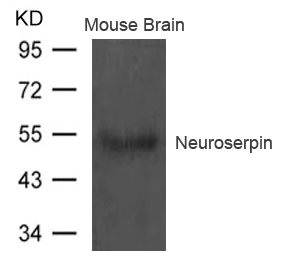
The antibody against SERPINI1 was raised in rabbit using the Peptide sequence around aa.402~406(T-S-G-H-D) derived from Human Neuroserpin. as the immunogen. Antibodies were produced by immunizing rabbits with synthetic peptide and KLH conjugates. Antibodies were purified by affinity-chromatography using epitope-specific peptide. This antibody has been validated on ELISA, WB.
$297.00
| Cat.No | ADC-43171A | Clonality | Polyclonal |
|---|---|---|---|
| Host Species | Rabbit | Target Name | SERPINI1 |
| Form | Liquid | Species Reactivity | Human, Mouse, Rat |
| Storage Buffer | PH 7.4, 0.02% sodium azide and 50% glycerol., 150mM NaCl, Supplied at 1.0mg/mL in phosphate buffered saline (without Mg2+ and Ca2+) | Purification Method | Antibodies were produced by immunizing rabbits with synthetic peptide and KLH conjugates. Antibodies were purified by affinity-chromatography using epitope-specific peptide. |
| Application | ELISA, WB | Storage | Upon receipt |
| Immunogen Description | Peptide sequence around aa.402~406(T-S-G-H-D) derived from Human Neuroserpin. | Target Species | Human |
|---|---|---|---|
| Immunogen Sequence | Complete sequences for the immunogen, target protein, and peptides are available upon request. | Uniprot ID | Q99574 |
Uniprot Id
Q99574
Target Species
Human
Target Name
SERPINI1
Target Full Name
Neuroserpin
Target Function
Serine protease inhibitor that inhibits plasminogen activators and plasmin but not thrombin. May be involved in the formation or reorganization of synaptic connections as well as for synaptic plasticity in the adult nervous system. May protect neurons from cell damage by tissue-type plasminogen activator (Probable).
Target Involvement
Encephalopathy, familial, with neuroserpin inclusion bodies (FENIB)
Target Subcellular Location
Secreted. Cytoplasmic vesicle, secretory vesicle lumen. Perikaryon.
Target Protein Families
Serpin family
Target Tissue Specificity
Detected in brain cortex and hippocampus pyramidal neurons (at protein level). Predominantly expressed in the brain.
Target Synonyms
DKFZp781N13156; Neuroserpin; NEUS_HUMAN; Peptidase inhibitor 12; PI-12; PI12; Protease inhibitor 12 ; Serine or cysteine proteinase inhibitor clade I (neuroserpin) member 1; Serine or cysteine proteinase inhibitor clade I member 1; Serpin I1; Serpin peptidase inhibitor clade I (neuroserpin) member 1; SERPINI1
Target Background
This gene encodes a member of the serpin superfamily of serine proteinase inhibitors. The protein is primarily secreted by axons in the brain, and preferentially reacts with and inhibits tissue-type plasminogen activator. It is thought to play a role in the regulation of axonal growth and the development of synaptic plasticity. Mutations in this gene result in familial encephalopathy with neuroserpin inclusion bodies (FENIB), which is a dominantly inherited form of familial encephalopathy and epilepsy characterized by the accumulation of mutant neuroserpin polymers. Multiple alternatively spliced variants, encoding the same protein, have been identified.
Notification