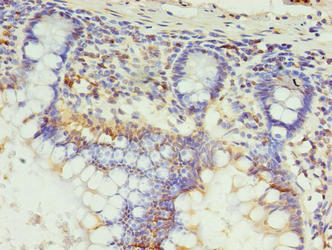
-
Chinese (Simplified)
-
English
-
German
-
Korean
-
Spanish
Chinese (Simplified)
English
German
Korean
Spanish
Sign up for an account to enjoy easy online shopping and instant order tracking.
The antibody against SETX was raised in rabbit using the Recombinant Human Probable helicase senataxin protein (2401-2677AA) as the immunogen. This antibody exists as a non-conjugated isotype IgG, purified by protein G with a purity greater than 95%. This antibody has been validated on ELISA, IHC.
$299.00
| Cat.No | ADC-23636A | Clonality | Polyclonal |
|---|---|---|---|
| Host Species | Rabbit | Target Name | SETX |
| Form | Liquid | Species Reactivity | Human |
| Isotype | IgG | Storage Buffer | 0.01M PBS, 0.03% Proclin 300; Constituents: 50% Glycerol, PH 7.4 |
| Purification Method | >95%, Protein G purified | Conjugate | Non-conjugated |
| Application | ELISA, IHC | Storage | Upon receipt |
| Immunogen Description | Recombinant Human Probable helicase senataxin protein (2401-2677AA) | Target Species | Human |
|---|---|---|---|
| Immunogen Sequence | Complete sequences for the immunogen, target protein, and peptides are available upon request. | Uniprot ID | Q7Z333 |
Uniprot Id
Q7Z333
Target Species
Human
Target Name
SETX
Target Full Name
Probable helicase senataxin
Target Function
Probable RNA/DNA helicase involved in diverse aspects of RNA metabolism and genomic integrity. Plays a role in transcription regulation by its ability to modulate RNA Polymerase II (Pol II) binding to chromatin and through its interaction with proteins involved in transcription. Contributes to the mRNA splicing efficiency and splice site selection. Required for the resolution of R-loop RNA-DNA hybrid formation at G-rich pause sites located downstream of the poly(A) site, allowing XRN2 recruitment and XRN2-mediated degradation of the downstream cleaved RNA and hence efficient RNA polymerase II (RNAp II) transcription termination. Required for the 3' transcriptional termination of PER1 and CRY2, thus playing an important role in the circadian rhythm regulation. Involved in DNA double-strand breaks damage response generated by oxidative stress. In association with RRP45, targets the RNA exosome complex to sites of transcription-induced DNA damage. Plays a role in the development and maturation of germ cells: essential for male meiosis, acting at the interface of transcription and meiotic recombination, and in the process of gene silencing during meiotic sex chromosome inactivation (MSCI). May be involved in telomeric stability through the regulation of telomere repeat-containing RNA (TERRA) transcription. Plays a role in neurite outgrowth in hippocampal cells through FGF8-activated signaling pathways. Inhibits retinoic acid-induced apoptosis.
Target Involvement
Spinocerebellar ataxia, autosomal recessive, 1 (SCAR1); Amyotrophic lateral sclerosis 4 (ALS4)
Target Subcellular Location
Nucleus. Nucleus, nucleoplasm. Nucleus, nucleolus. Cytoplasm. Chromosome. Chromosome, telomere. Cell projection, axon. Cell projection, growth cone.
Target Protein Families
DNA2/NAM7 helicase family
Target Tissue Specificity
Highly expressed in skeletal muscle. Expressed in heart, fibroblast, placenta and liver. Weakly expressed in brain and lung. Expressed in the cortex of the kidney (highly expressed in tubular epithelial cells but low expression in the glomerulus).
Target Synonyms
ALS4; Amyotrophic lateral sclerosis 4 protein; AOA2; bA479K20.2; DKFZp781B151; FLJ12840; FLJ43459; KIAA0625; Probable helicase senataxin; SCAR1; SEN1 homolog; Setx; SETX_HUMAN
Notification