-
Chinese (Simplified)
-
English
-
German
-
Korean
-
Spanish
Chinese (Simplified)
English
German
Korean
Spanish
Sign up for an account to enjoy easy online shopping and instant order tracking.
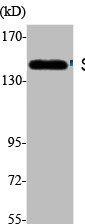
The antibody against SF3B1 was raised in rabbit using the Synthesized peptide derived from the N-terminal region of Human SAP 155. as the immunogen. This antibody exists as a non-conjugated isotype IgG. The antibody was affinity-purified from rabbit antiserum by affinity-chromatography using epitope-specific immunogen. This antibody has been validated on WB, ELISA.
$167.00
| Cat.No | ADC-37308A | Clonality | Polyclonal |
|---|---|---|---|
| Host Species | Rabbit | Target Name | SF3B1 |
| Target Synonyms | 155kDa antibody, Hsh155 antibody; OTTHUMP00000205700 antibody; OTTHUMP00000205702 antibody; OTTHUMP00000225001 antibody; OTTHUMP00000225002 antibody; Pre mRNA processing 10 antibody; Pre mRNA splicing factor SF3b, subunit 1 | Form | Liquid |
| Species Reactivity | Human, Mouse | Isotype | IgG |
| Storage Buffer | 0.5% BSA and 0.02% sodium azide., Liquid in PBS containing 50% glycerol | Purification Method | The antibody was affinity-purified from rabbit antiserum by affinity-chromatography using epitope-specific immunogen. |
| Conjugate | Non-conjugated | Application | ELISA, WB |
| Storage | Upon receipt |
| Immunogen Description | Synthesized peptide derived from the N-terminal region of Human SAP 155. | Target Species | Human |
|---|---|---|---|
| Immunogen Sequence | Complete sequences for the immunogen, target protein, and peptides are available upon request. | Uniprot ID | O75533 |
Uniprot Id
O75533
Target Species
Human
Target Name
SF3B1
Target Full Name
Splicing factor 3B subunit 1
Target Function
Involved in pre-mRNA splicing as a component of the splicing factor SF3B complex. SF3B complex is required for 'A' complex assembly formed by the stable binding of U2 snRNP to the branchpoint sequence (BPS) in pre-mRNA. Sequence independent binding of SF3A/SF3B complex upstream of the branch site is essential, it may anchor U2 snRNP to the pre-mRNA. Together with other U2 snRNP complex components may also play a role in the selective processing of microRNAs (miRNAs) from the long primary miRNA transcript, pri-miR-17-92. May also be involved in the assembly of the 'E' complex. Belongs also to the minor U12-dependent spliceosome, which is involved in the splicing of rare class of nuclear pre-mRNA intron.
Target Subcellular Location
Nucleus. Nucleus speckle. Note=During mitosis, transiently dispersed from the nuclear speckles to the cytoplasm.
Target Protein Families
SF3B1 family
Target Research Area
Epigenetics and Nuclear Signaling
Target Synonyms
Hsh155; OTTHUMP00000205700; OTTHUMP00000205702; OTTHUMP00000225001; OTTHUMP00000225002; Pre mRNA processing 10; Pre mRNA splicing factor SF3b, 155 kDa subunit; Pre-mRNA splicing factor SF3b 155 kDa subunit; Pre-mRNA-splicing factor SF3b 155 kDa subunit; PRP10; PRPF10; SAP 155; SAP155; sf3b1; SF3B1_HUMAN; SF3b155; Spliceosome associated protein 155; Spliceosome-associated protein 155; Splicing factor 3B subunit 1; Splicing factor 3b, subunit 1, 155kDa
Target Background
This gene encodes subunit 1 of the splicing factor 3b protein complex. Splicing factor 3b, together with splicing factor 3a and a 12S RNA unit, forms the U2 small nuclear ribonucleoproteins complex (U2 snRNP). The splicing factor 3b/3a complex binds pre-mRNA upstream of the intron's branch site in a sequence independent manner and may anchor the U2 snRNP to the pre-mRNA. Splicing factor 3b is also a component of the minor U12-type spliceosome. The carboxy-terminal two-thirds of subunit 1 have 22 non-identical, tandem HEAT repeats that form rod-like, helical structures. Alternative splicing results in multiple transcript variants encoding different isoforms.
Notification