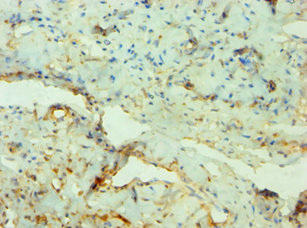
-
Chinese (Simplified)
-
English
-
German
-
Korean
-
Spanish

Chinese (Simplified)
English
German
Korean
Spanish
Sign up for an account to enjoy easy online shopping and instant order tracking.
The antibody against SGK3 was raised in rabbit using the Recombinant Human Serine/threonine-protein kinase Sgk3 protein (1-150AA) as the immunogen. This antibody exists as a non-conjugated isotype IgG, Antigen affinity purified. This antibody has been validated on ELISA, IHC.
$299.00
| Cat.No | ADC-44206A | Clonality | Polyclonal |
|---|---|---|---|
| Host Species | Rabbit | Target Name | SGK3 |
| Form | Liquid | Species Reactivity | Human |
| Isotype | IgG | Storage Buffer | 50% Glycerol, PBS with 0.02% sodium azide, pH7.3. |
| Purification Method | Antigen affinity purified | Conjugate | Non-conjugated |
| Application | ELISA, IHC | Storage | Upon receipt |
| Immunogen Description | Recombinant Human Serine/threonine-protein kinase Sgk3 protein (1-150AA) | Target Species | Human |
|---|---|---|---|
| Immunogen Sequence | Complete sequences for the immunogen, target protein, and peptides are available upon request. | Uniprot ID | Q96BR1 |
Uniprot Id
Q96BR1
Target Species
Human
Target Name
SGK3
Target Full Name
Serine/threonine-protein kinase Sgk3
Target Function
Serine/threonine-protein kinase which is involved in the regulation of a wide variety of ion channels, membrane transporters, cell growth, proliferation, survival and migration. Up-regulates Na(+) channels: SCNN1A/ENAC and SCN5A, K(+) channels: KCNA3/KV1.3, KCNE1, KCNQ1 and KCNH2/HERG, epithelial Ca(2+) channels: TRPV5 and TRPV6, chloride channel: BSND, creatine transporter: SLC6A8, Na(+)/dicarboxylate cotransporter: SLC13A2/NADC1, Na(+)-dependent phosphate cotransporter: SLC34A2/NAPI-2B, amino acid transporters: SLC1A5/ASCT2 and SLC6A19, glutamate transporters: SLC1A3/EAAT1, SLC1A6/EAAT4 and SLC1A7/EAAT5, glutamate receptors: GRIA1/GLUR1 and GRIK2/GLUR6, Na(+)/H(+) exchanger: SLC9A3/NHE3, and the Na(+)/K(+) ATPase. Plays a role in the regulation of renal tubular phosphate transport and bone density. Phosphorylates NEDD4L and GSK3B. Positively regulates ER transcription activity through phosphorylation of FLII. Negatively regulates the function of ITCH/AIP4 via its phosphorylation and thereby prevents CXCR4 from being efficiently sorted to lysosomes.
Target Subcellular Location
Cytoplasmic vesicle. Early endosome. Recycling endosome. Note=Endosomal localization is a prerequisite for complete kinase activity. It is essential for its colocalization with the kinase responsible for phosphorylating Ser-486 thus allowing PDPK1 phosphorylation of Thr-320 resulting in complete activation of SGK3. Localized in vesicle-like structures and in the early endosome. Colocalizes with SLC9A3/NHE3 in the recycling endosomes.
Target Protein Families
Protein kinase superfamily, AGC Ser/Thr protein kinase family
Target Tissue Specificity
Expressed in most tissues with highest levels in pancreas, kidney liver, heart and brain and lower levels in lung, placenta and skeletal muscle. Expression is higher in ER-positive breast tumors than ER-negative breast tumors.
Target Synonyms
CISK; Cytokine independent survival kinase; DKFZp781N0293; Serine/threonine protein kinase Sgk3; Serine/threonine-protein kinase Sgk3; Serum/glucocorticoid regulated kinase 3; Serum/glucocorticoid regulated kinase family member 3; Serum/glucocorticoid regulated kinase like; Serum/glucocorticoid-regulated kinase 3; Serum/glucocorticoid-regulated kinase-like; SGK 2; SGK 3; SGK2; Sgk3; SGK3_HUMAN; SGKL
Target Background
This gene is a member of the Ser/Thr protein kinase family and encodes a phosphoprotein with a PX (phox homology) domain. The protein phosphorylates several target proteins and has a role in neutral amino acid transport and activation of potassium and chloride channels. Alternate transcriptional splice variants, encoding different isoforms, have been characterized.
Notification