-
Chinese (Simplified)
-
English
-
German
-
Korean
-
Spanish
Chinese (Simplified)
English
German
Korean
Spanish
Sign up for an account to enjoy easy online shopping and instant order tracking.
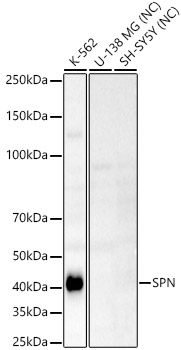
The antibody against SPN was raised in Rabbit using the recombinant fusion protein containing a sequence corresponding to amino acids 276-400 of human SPN (NP_003114.1) as the immunogen. The polyclonal antibody exists as a isotype IgG, by affinity purification. This antibody has been validated on WB, IHC-P, IF/ICC, ELISA.
| Cat.No | ADA-11106A | Clonality | Polyclonal |
|---|---|---|---|
| Host Species | Rabbit | Target Name | SPN |
| Target Synonyms | LSN; CD43; GALGP; GPL115; LEU-22; SPN | Form | Liquid |
| Species Reactivity | Human, Mouse, Rat | Isotype | IgG |
| Storage Buffer | 50% Glycerol, PBS with 0.05% proclin300, pH7.3. | Purification Method | Affinity purification |
| Positive Samples | Mouse spleen, Rat thymus, U-937 | Application | ELISA, WB, IF/ICC, IHC-P |
| Immunogen Description | Recombinant fusion protein containing a sequence corresponding to amino acids 276-400 of human SPN (NP_003114.1). | Target Species | Human |
|---|---|---|---|
| Immunogen Sequence | LWRRRQKRRTGALVLSRGGKRNGVVDAWAGPAQVPEEGAVTVTVGGSGGDKGSGFPDGEGSSRRPTLTTFFGRRKSRQGSLAMEELKSGSGPSLKGEEEPLVASEDGAVDAPAPDEPEGGDGAAP | Uniprot ID | P16150 |
Uniprot Id
P16150
Target Species
Human
Target Name
SPN
Target Full Name
Leukosialin
Target Function
Predominant cell surface sialoprotein of leukocytes which regulates multiple T-cell functions, including T-cell activation, proliferation, differentiation, trafficking and migration. Positively regulates T-cell trafficking to lymph-nodes via its association with ERM proteins (EZR, RDX and MSN). Negatively regulates Th2 cell differentiation and predisposes the differentiation of T-cells towards a Th1 lineage commitment. Promotes the expression of IFN-gamma by T-cells during T-cell receptor (TCR) activation of naive cells and induces the expression of IFN-gamma by CD4(+) T-cells and to a lesser extent by CD8(+) T-cells. Plays a role in preparing T-cells for cytokine sensing and differentiation into effector cells by inducing the expression of cytokine receptors IFNGR and IL4R, promoting IFNGR and IL4R signaling and by mediating the clustering of IFNGR with TCR. Acts as a major E-selectin ligand responsible for Th17 cell rolling on activated vasculature and recruitment during inflammation. Mediates Th17 cells, but not Th1 cells, adhesion to E-selectin. Acts as a T-cell counter-receptor for SIGLEC1.; Protects cells from apoptotic signals, promoting cell survival.
Target Subcellular Location
Membrane; Single-pass type I membrane protein. Cell projection, microvillus. Cell projection, uropodium.; [CD43 cytoplasmic tail]: Nucleus. Nucleus, PML body.
Target Tissue Specificity
Cell surface of thymocytes, T-lymphocytes, neutrophils, plasma cells and myelomas.
Target Research Area
Immunology
Target Synonyms
CD 43; CD43; CD43 antigen; Galactoglycoprotein; GALGP; GPL 115; GPL115; Human gene for sialophorin ; Leucocyte sialoglycoprotein; LEUK_HUMAN; Leukocyte large sialoglycoprotein; Leukocyte sialoglycoprotein; Leukosialin; LSN; Ly-48; sialophorin (gpL115, leukosialin, CD43); Sialophorin; Spn
Target Background
This gene encodes a highly sialylated glycoprotein that functions in antigen-specific activation of T cells, and is found on the surface of thymocytes, T lymphocytes, monocytes, granulocytes, and some B lymphocytes. It contains a mucin-like extracellular domain, a transmembrane region and a carboxy-terminal intracellular region. The extracellular domain has a high proportion of serine and threonine residues, allowing extensive O-glycosylation, and has one potential N-glycosylation site, while the carboxy-terminal region has potential phosphorylation sites that may mediate transduction of activation signals. Different glycoforms of this protein have been described. In stimulated immune cells, proteolytic cleavage of the extracellular domain occurs in some cell types, releasing a soluble extracellular fragment. Defects in expression of this gene are associated with Wiskott-Aldrich syndrome.
Notification