• Contact info@abtriva.com for inquiries and orders.
  • Chinese (Simplified)

  • English

  • German

  • Korean

  • Spanish

United States (English / $ USD)

Rabbit anti-Human SRSF10 Polyclonal Antibody

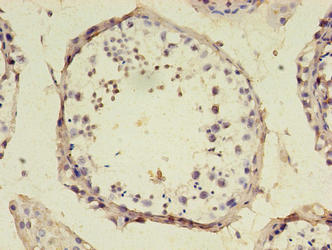
The antibody against SRSF10 was raised in rabbit using the Recombinant Human Serine/arginine-rich splicing factor 10 protein (1-183AA) as the immunogen. This antibody exists as a non-conjugated isotype IgG, purified by protein G with a purity greater than 95%. This antibody has been validated on ELISA, IHC.

ADC-32838A

The antibody against SRSF10 was raised in rabbit using the Recombinant Human Serine/arginine-rich splicing factor 10 protein (1-183AA) as the immunogen. This antibody exists as a non-conjugated isotype IgG, purified by protein G with a purity greater than 95%. This antibody has been validated on ELISA, IHC.

$299.00

Number
Order Exclusive Products Now

Request a Quote
High Purity LevelsPrecision and ReliabilityCustomization Options

Specifications


Cat.No ADC-32838A ClonalityPolyclonal
Host SpeciesRabbitTarget NameSRSF10
FormLiquidSpecies ReactivityHuman
IsotypeIgGStorage Buffer0.01M PBS, 0.03% Proclin 300; Constituents: 50% Glycerol, PH 7.4
Purification Method>95%, Protein G purifiedConjugateNon-conjugated
ApplicationELISA, IHCStorageUpon receipt

Immunogen Information


Immunogen DescriptionRecombinant Human Serine/arginine-rich splicing factor 10 protein (1-183AA)Target SpeciesHuman
Immunogen SequenceComplete sequences for the immunogen, target protein, and peptides are available upon request.Uniprot IDO75494
Background Information
  • Uniprot Id

    O75494

  • Target Species

    Human

  • Target Name

    SRSF10

  • Target Full Name

    Serine/arginine-rich splicing factor 10

  • Target Function

    Splicing factor that in its dephosphorylated form acts as a general repressor of pre-mRNA splicing. Seems to interfere with the U1 snRNP 5'-splice recognition of SNRNP70. Required for splicing repression in M-phase cells and after heat shock. Also acts as a splicing factor that specifically promotes exon skipping during alternative splicing. Interaction with YTHDC1, a RNA-binding protein that recognizes and binds N6-methyladenosine (m6A)-containing RNAs, prevents SRSF10 from binding to its mRNA-binding sites close to m6A-containing regions, leading to inhibit exon skipping during alternative splicing. May be involved in regulation of alternative splicing in neurons, with isoform 1 acting as a positive and isoform 3 as a negative regulator.

  • Target Subcellular Location

    Nucleus speckle. Cytoplasm.

  • Target Protein Families

    Splicing factor SR family

  • Target Tissue Specificity

    Widely expressed.

  • Target Research Area

    Epigenetics and Nuclear Signaling

  • Target Synonyms

    40 kDa SR repressor protein; 40 kDa SR-repressor protein; Anti TLS associated protein with SR repeats; arginine/serine-rich 13A; FUS interacting protein serine arginine rich 1; FUS interacting protein serine arginine rich 2; FUS interacting serine arginine rich protein 1; FUS-interacting serine-arginine-rich protein 1; FUSIP1; FUSIP2; NSSR; OTTHUMP00000015774; Serine arginine repressor protein 40 kDa; Serine/arginine-rich splicing factor 10; SFRS13; SFRS13A; Splicing factor; Splicing factor arginine serine rich 13; Splicing factor SRp38; SRp38; SRp40; SRrp40; SRS10_HUMAN; Srsf10; TASR; TASR1; TASR2; TLS associated protein TASR1; TLS associated protein TASR2; TLS associated protein with Ser Arg repeats; TLS associated protein with SR repeats; TLS associated serine arginine protein 1; TLS associated serine arginine protein 2; TLS associated serine arginine protein; TLS associated SR protein; TLS-associated protein with Ser-Arg repeats; TLS-associated protein with SR repeats; TLS-associated serine-arginine protein; TLS-associated SR protein

  • Target Background

    This gene product is a member of the serine-arginine (SR) family of proteins, which are involved in constitutive and regulated RNA splicing. Members of this family are characterized by N-terminal RNP1 and RNP2 motifs, which are required for binding to RNA, and multiple C-terminal SR/RS repeats, which are important in mediating association with other cellular proteins. This protein interacts with the oncoprotein TLS, and abrogates the influence of TLS on adenovirus E1A pre-mRNA splicing. This gene has pseudogenes on chromosomes 4, 9, 14, 18, and 20. Alternative splicing results in multiple transcript variants.

Inquire Rabbit anti-Human SRSF10 Polyclonal Antibody Now


AbTriva respects your privacy and protects your personal data in accordance with AbTriva. For more information, please see our data protection statement. *

Notification