-
Chinese (Simplified)
-
English
-
German
-
Korean
-
Spanish

Chinese (Simplified)
English
German
Korean
Spanish
Sign up for an account to enjoy easy online shopping and instant order tracking.
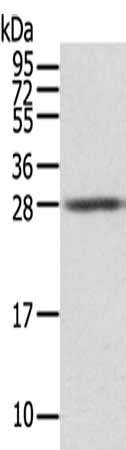
The antibody against STX8 was raised in rabbit using the Fusion protein of Human STX8 as the immunogen. This antibody exists as a non-conjugated isotype IgG, Antigen affinity purified. This antibody has been validated on ELISA, WB, IHC.
$299.00
| Cat.No | ADC-29190A | Clonality | Polyclonal |
|---|---|---|---|
| Host Species | Rabbit | Target Name | STX8 |
| Target Synonyms | CARB antibody; STX 8 antibody; Stx8 antibody; STX8_HUMAN antibody; Syntaxin-8 antibody; Syntaxin8 antibody | Form | Liquid |
| Species Reactivity | Human, Mouse, Rat | Isotype | IgG |
| Storage Buffer | 0.05% NaN3, 40% Glycerol., pH7.4 PBS | Purification Method | Antigen affinity purified |
| Conjugate | Non-conjugated | Application | ELISA, IHC, WB |
| Storage | Upon receipt |
| Immunogen Description | Fusion protein of Human STX8 | Target Species | Human |
|---|---|---|---|
| Immunogen Sequence | Complete sequences for the immunogen, target protein, and peptides are available upon request. | Uniprot ID | Q9UNK0 |
Uniprot Id
Q9UNK0
Target Species
Human
Target Name
STX8
Target Full Name
Syntaxin-8
Target Function
Vesicle trafficking protein that functions in the early secretory pathway, possibly by mediating retrograde transport from cis-Golgi membranes to the ER.
Target Subcellular Location
Membrane; Single-pass type IV membrane protein.
Target Protein Families
Syntaxin family
Target Tissue Specificity
Highly expressed in heart. Also found in brain, kidney, liver, lung, placenta, skeletal muscle, spleen and pancreas.
Target Synonyms
CARB; STX 8; Stx8; STX8_HUMAN; Syntaxin-8; Syntaxin8
Target Background
The gene is a member of the syntaxin family. The encoded protein is involved in protein trafficking from early to late endosomes via vesicle fusion and exocytosis. A related pseudogene has been identified on chromosome 12. Alternative splicing results in multiple transcript variants.
Notification