• Contact info@abtriva.com for inquiries and orders.
  • Chinese (Simplified)

  • English

  • German

  • Korean

  • Spanish

United States (English / $ USD)

Rabbit anti-Human TAB3 Polyclonal Antibody

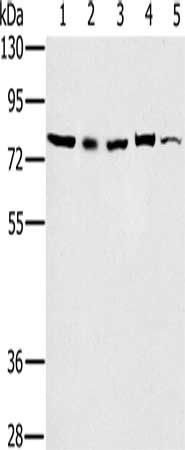
The antibody against TAB3 was raised in rabbit using the Fusion protein of Human TAB3 as the immunogen. This antibody exists as a non-conjugated isotype IgG, Antigen affinity purified. This antibody has been validated on ELISA, WB, IHC.

ADC-29727A

The antibody against TAB3 was raised in rabbit using the Fusion protein of Human TAB3 as the immunogen. This antibody exists as a non-conjugated isotype IgG, Antigen affinity purified. This antibody has been validated on ELISA, WB, IHC.

$299.00

Number
Order Exclusive Products Now

Request a Quote
High Purity LevelsPrecision and ReliabilityCustomization Options

Specifications


Cat.No ADC-29727A ClonalityPolyclonal
Host SpeciesRabbitTarget NameTAB3
FormLiquidSpecies ReactivityHuman, Mouse
IsotypeIgGStorage Buffer0.05% NaN3, 40% Glycerol., pH7.4 PBS
Purification MethodAntigen affinity purifiedConjugateNon-conjugated
ApplicationELISA, IHC, WBStorageUpon receipt

Immunogen Information


Immunogen DescriptionFusion protein of Human TAB3Target SpeciesHuman
Immunogen SequenceComplete sequences for the immunogen, target protein, and peptides are available upon request.Uniprot IDQ8N5C8
Background Information
  • Uniprot Id

    Q8N5C8

  • Target Species

    Human

  • Target Name

    TAB3

  • Target Full Name

    TGF-beta-activated kinase 1 and MAP3K7-binding protein 3

  • Target Function

    Adapter required to activate the JNK and NF-kappa-B signaling pathways through the specific recognition of 'Lys-63'-linked polyubiquitin chains by its RanBP2-type zinc finger (NZF). Acts as an adapter linking MAP3K7/TAK1 and TRAF6 to 'Lys-63'-linked polyubiquitin chains. The RanBP2-type zinc finger (NZF) specifically recognizes Lys-63'-linked polyubiquitin chains unanchored or anchored to the substrate proteins such as RIPK1/RIP1: this acts as a scaffold to organize a large signaling complex to promote autophosphorylation of MAP3K7/TAK1, and subsequent activation of I-kappa-B-kinase (IKK) core complex by MAP3K7/TAK1.; May be an oncogenic factor.

  • Target Tissue Specificity

    Widely expressed. Constitutively overexpressed in certain tumor tissues.; [Isoform 1]: Major transcript.; [Isoform 2]: Minor transcript.

  • Target Synonyms

    MAP3K7IP 3; Mitogen-activated protein kinase kinase kinase 7-interacting protein 3; NAP1 ; NF-kappa-B-activating protein 1; NFkB activating protein 1; TAB-3; Tab3; TAB3_HUMAN; TAK1 binding protein 3; TAK1-binding protein 3; TGF-beta-activated kinase 1 and MAP3K7-binding protein 3; TGF-beta-activated kinase 1-binding protein 3

  • Target Background

    The product of this gene functions in the NF-kappaB signal transduction pathway. The encoded protein, and the similar and functionally redundant protein MAP3K7IP2/TAB2, forms a ternary complex with the protein kinase MAP3K7/TAK1 and either TRAF2 or TRAF6 in response to stimulation with the pro-inflammatory cytokines TNF or IL-1. Subsequent MAP3K7/TAK1 kinase activity triggers a signaling cascade leading to activation of the NF-kappaB transcription factor. The human genome contains a related pseudogene. Alternatively spliced transcript variants have been described, but their biological validity has not been determined.

Inquire Rabbit anti-Human TAB3 Polyclonal Antibody Now


AbTriva respects your privacy and protects your personal data in accordance with AbTriva. For more information, please see our data protection statement. *

Notification