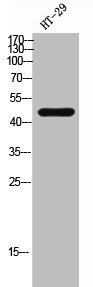
-
Chinese (Simplified)
-
English
-
German
-
Korean
-
Spanish
Chinese (Simplified)
English
German
Korean
Spanish
Sign up for an account to enjoy easy online shopping and instant order tracking.
The antibody against TANK was raised in rabbit using the Synthesized peptide derived from the Internal region of Human TANK. as the immunogen. This antibody exists as a non-conjugated isotype IgG. The antibody was affinity-purified from rabbit antiserum by affinity-chromatography using epitope-specific immunogen. This antibody has been validated on WB, IHC, IF, ELISA.
$167.00
| Cat.No | ADC-36709A | Clonality | Polyclonal |
|---|---|---|---|
| Host Species | Rabbit | Target Name | TANK |
| Form | Liquid | Species Reactivity | Human, Mouse, Rat |
| Isotype | IgG | Storage Buffer | 0.5% BSA and 0.02% sodium azide., Liquid in PBS containing 50% glycerol |
| Purification Method | The antibody was affinity-purified from rabbit antiserum by affinity-chromatography using epitope-specific immunogen. | Conjugate | Non-conjugated |
| Application | ELISA, IF, IHC, WB | Storage | Upon receipt |
| Immunogen Description | Synthesized peptide derived from the Internal region of Human TANK. | Target Species | Human |
|---|---|---|---|
| Immunogen Sequence | Complete sequences for the immunogen, target protein, and peptides are available upon request. | Uniprot ID | Q92844 |
Uniprot Id
Q92844
Target Species
Human
Target Name
TANK
Target Full Name
TRAF family member-associated NF-kappa-B activator
Target Function
Adapter protein involved in I-kappa-B-kinase (IKK) regulation which constitutively binds TBK1 and IKBKE playing a role in antiviral innate immunity. Acts as a regulator of TRAF function by maintaining them in a latent state. Blocks TRAF2 binding to LMP1 and inhibits LMP1-mediated NF-kappa-B activation. Negatively regulates NF-kappaB signaling and cell survival upon DNA damage. Plays a role as an adapter to assemble ZC3H12A, USP10 in a deubiquitination complex which plays a negative feedback response to attenuate NF-kappaB activation through the deubiquitination of IKBKG or TRAF6 in response to interleukin-1-beta (IL1B) stimulation or upon DNA damage. Promotes UBP10-induced deubiquitination of TRAF6 in response to DNA damage. May control negatively TRAF2-mediated NF-kappa-B activation signaled by CD40, TNFR1 and TNFR2.
Target Subcellular Location
Cytoplasm.
Target Tissue Specificity
Ubiquitous.
Target Research Area
Signal Transduction
Target Synonyms
I TRAF; I-TRAF; ITRAF; Tank; TANK_HUMAN; TRAF family member associated NF KAPPA B activator; TRAF family member associated NFKB activator; TRAF family member-associated NF-kappa-B activator; TRAF interacting protein; TRAF interacting protein TANK isoform a; TRAF interacting protein TANK isoform b; TRAF-interacting protein; TRAF2
Target Background
The TRAF (tumor necrosis factor receptor-associated factor) family of proteins associate with and transduce signals from members of the tumor necrosis factor receptor superfamily. The protein encoded by this gene is found in the cytoplasm and can bind to TRAF1, TRAF2, or TRAF3, thereby inhibiting TRAF function by sequestering the TRAFs in a latent state in the cytoplasm. For example, the protein encoded by this gene can block TRAF2 binding to LMP1, the Epstein-Barr virus transforming protein, and inhibit LMP1-mediated NF-kappa-B activation. Three alternatively spliced transcript variants encoding different isoforms have been found for this gene.
Notification