-
Chinese (Simplified)
-
English
-
German
-
Korean
-
Spanish
Chinese (Simplified)
English
German
Korean
Spanish
Sign up for an account to enjoy easy online shopping and instant order tracking.
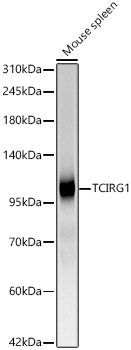
The antibody against TCIRG1 was raised in Rabbit using the recombinant fusion protein containing a sequence corresponding to aminoacids 1-356 of human TCIRG1(NP_006010.2?) as the immunogen. The monoclonal antibody exists as a isotype IgG, by affinity purification. This antibody has been validated on WB, IHC-P, IF/ICC, ELISA.
| Cat.No | ADA-16440A | Clonality | Monoclonal |
|---|---|---|---|
| Host Species | Rabbit | Target Name | TCIRG1 |
| Target Synonyms | a3; Stv1; Vph1; Atp6i; OC116; OPTB1; TIRC7; ATP6N1C; ATP6V0A3; OC-116kDa; TCIRG1 | Form | Liquid |
| Species Reactivity | Human, Mouse, Rat | Isotype | IgG |
| Storage Buffer | 50% Glycerol, 0.05% BSA, PBS with 0.05% proclin300, pH7.3. | Purification Method | Affinity purification |
| Positive Samples | Mouse spleen | Application | ELISA, WB, IF/ICC, IHC-P |
| Immunogen Description | Recombinant fusion protein containing a sequence corresponding to aminoacids 1-356 of human TCIRG1(NP_006010.2?). | Target Species | Human |
|---|---|---|---|
| Uniprot ID | Q13488 | Immunogen Sequence |
Uniprot Id
Q13488
Target Species
Human
Target Name
TCIRG1
Target Full Name
V-type proton ATPase 116 kDa subunit a 3
Target Function
Part of the proton channel of V-ATPases. Seems to be directly involved in T-cell activation.
Target Involvement
Osteopetrosis, autosomal recessive 1 (OPTB1)
Target Subcellular Location
Membrane; Multi-pass membrane protein.
Target Protein Families
V-ATPase 116 kDa subunit family
Target Tissue Specificity
Isoform long is highly expressed in osteoclastomas. Isoform short is highly expressed in thymus.
Target Synonyms
a3; Atp 6i; Atp6i; ATP6N1C; ATP6V0A3; ATPase H+ transporting 116kD; OC 116; OC 116 kDa; OC 116kDa; OC-116 kDa; OC116; OPTB 1; OPTB1; Osteoclastic proton pump 116 kDa subunit; Specific 116 kDa vacuolar proton pump subunit; Stv 1; Stv1; T cell immune regulator 1; T cell immune regulator 1 ATPase H+ transporting lysosomal V0 subunit A; T cell immune regulator 1 ATPase H+ transporting lysosomal V0 subunit A3; T cell immune response cDNA 7; T cell immune response cDNA7 protein; T cell, immune regulator 1, ATPase, H+ transporting, lysosomal V0 protein a; T-cell immune regulator 1; T-cell immune response cDNA7 protein; TCIRG 1; TCIRG1; TIRC 7; TIRC7; V ATPase 116 kDa; V ATPase 116 kDa isoform a3; V type proton ATPase 116 kDa subunit a; V-ATPase 116 kDa isoform a3; V-type proton ATPase 116 kDa subunit a isoform 3; Vacuolar proton translocating ATPase 116 kDa subunit A; Vacuolar proton translocating ATPase 116 kDa subunit a isoform 3; Vph 1; Vph1; VPP3_HUMAN
Target Background
This gene encodes a subunit of a large protein complex known as a vacuolar H+-ATPase (V-ATPase). The protein complex acts as a pump to move protons across the membrane. This movement of protons helps regulate the pH of cells and their surrounding environment. V-ATPase dependent organelle acidification is necessary for such intracellular processes as protein sorting, zymogen activation, and receptor-mediated endocytosis. V-ATPase is comprised of a cytosolic V1 domain and a transmembrane V0 domain. Alternative splicing results in multiple transcript variants. Mutations in this gene are associated with infantile malignant osteopetrosis.
Notification