-
Chinese (Simplified)
-
English
-
German
-
Korean
-
Spanish
Chinese (Simplified)
English
German
Korean
Spanish
Sign up for an account to enjoy easy online shopping and instant order tracking.
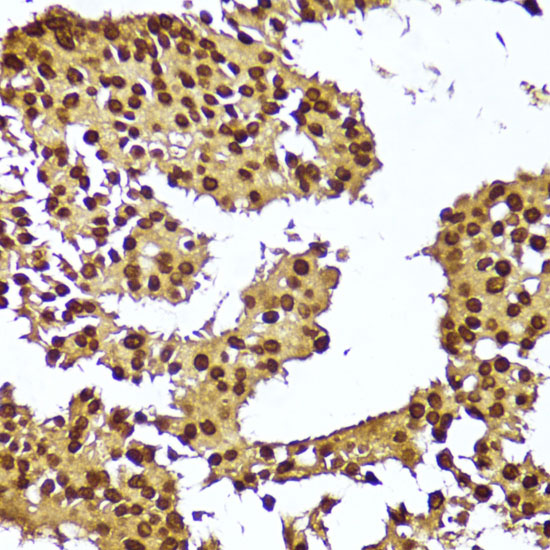
The antibody against TERT was raised in Rabbit using a synthetic peptide corresponding to a sequence within amino acids 1050-1132 of human TERT (NP_937983.2) as the immunogen. The polyclonal antibody exists as a isotype IgG, by affinity purification. This antibody has been validated on WB, IHC-P, ELISA.
| Cat.No | ADA-11660A | Clonality | Polyclonal |
|---|---|---|---|
| Host Species | Rabbit | Target Name | TERT |
| Target Synonyms | TP2; TRT; CMM9; EST2; TCS1; hTRT; DKCA2; DKCB4; hEST2; PFBMFT1; TERT | Form | Liquid |
| Species Reactivity | Human, Mouse | Isotype | IgG |
| Storage Buffer | 50% Glycerol, PBS with 0.02% sodium azide, pH7.3. | Purification Method | Affinity purification |
| Application | ELISA, WB, IHC-P |
| Immunogen Description | A synthetic peptide corresponding to a sequence within amino acids 1050-1132 of human TERT (NP_937983.2). | Target Species | Human |
|---|---|---|---|
| Immunogen Sequence | KNAGMSLGAKGAAGPLPSEAVQWLCHQAFLLKLTRHRVTYVPLLGSLRTAQTQLSRKLPGTTLTALEAAANPALPSDFKTILD | Uniprot ID | O14746 |
Uniprot Id
O14746
Target Species
Human
Target Name
TERT
Target Full Name
Telomerase reverse transcriptase
Target Function
Telomerase is a ribonucleoprotein enzyme essential for the replication of chromosome termini in most eukaryotes. Active in progenitor and cancer cells. Inactive, or very low activity, in normal somatic cells. Catalytic component of the teleromerase holoenzyme complex whose main activity is the elongation of telomeres by acting as a reverse transcriptase that adds simple sequence repeats to chromosome ends by copying a template sequence within the RNA component of the enzyme. Catalyzes the RNA-dependent extension of 3'-chromosomal termini with the 6-nucleotide telomeric repeat unit, 5'-TTAGGG-3'. The catalytic cycle involves primer binding, primer extension and release of product once the template boundary has been reached or nascent product translocation followed by further extension. More active on substrates containing 2 or 3 telomeric repeats. Telomerase activity is regulated by a number of factors including telomerase complex-associated proteins, chaperones and polypeptide modifiers. Modulates Wnt signaling. Plays important roles in aging and antiapoptosis.
Target Involvement
Aplastic anemia (AA); Dyskeratosis congenita, autosomal dominant, 2 (DKCA2); Pulmonary fibrosis, and/or bone marrow failure, telomere-related, 1 (PFBMFT1); Dyskeratosis congenita, autosomal recessive, 4 (DKCB4); Pulmonary fibrosis, idiopathic (IPF); Melanoma, cutaneous malignant 9 (CMM9)
Target Subcellular Location
Nucleus, nucleolus. Nucleus, nucleoplasm. Nucleus. Chromosome, telomere. Cytoplasm. Nucleus, PML body. Note=Shuttling between nuclear and cytoplasm depends on cell cycle, phosphorylation states, transformation and DNA damage. Diffuse localization in the nucleoplasm. Enriched in nucleoli of certain cell types. Translocated to the cytoplasm via nuclear pores in a CRM1/RAN-dependent manner involving oxidative stress-mediated phosphorylation at Tyr-707. Dephosphorylation at this site by SHP2 retains TERT in the nucleus. Translocated to the nucleus by phosphorylation by AKT.
Target Protein Families
Reverse transcriptase family, Telomerase subfamily
Target Tissue Specificity
Expressed at a high level in thymocyte subpopulations, at an intermediate level in tonsil T-lymphocytes, and at a low to undetectable level in peripheral blood T-lymphocytes.
Target Research Area
others
Target Synonyms
CMM9; DKCA2; DKCB4; EST2; HEST2; htert; hTRT; PFBMFT1; TCS1; Telomerase associated protein 2; Telomerase catalytic subunit; Telomerase reverse transcriptase; Telomerase-associated protein 2; Telomere Reverse Transcriptase; TERT; TERT_HUMAN; TP2; TRT
Target Background
Telomerase is a ribonucleoprotein polymerase that maintains telomere ends by addition of the telomere repeat TTAGGG. The enzyme consists of a protein component with reverse transcriptase activity, encoded by this gene, and an RNA component which serves as a template for the telomere repeat. Telomerase expression plays a role in cellular senescence, as it is normally repressed in postnatal somatic cells resulting in progressive shortening of telomeres. Deregulation of telomerase expression in somatic cells may be involved in oncogenesis. Studies in mouse suggest that telomerase also participates in chromosomal repair, since de novo synthesis of telomere repeats may occur at double-stranded breaks. Alternatively spliced variants encoding different isoforms of telomerase reverse transcriptase have been identified; the full-length sequence of some variants has not been determined. Alternative splicing at this locus is thought to be one mechanism of regulation of telomerase activity.
Notification