-
Chinese (Simplified)
-
English
-
German
-
Korean
-
Spanish
Chinese (Simplified)
English
German
Korean
Spanish
Sign up for an account to enjoy easy online shopping and instant order tracking.
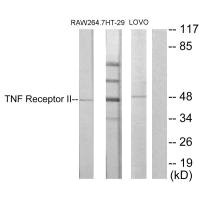
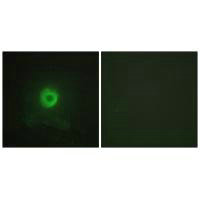
The antibody against TNFRSF1B was raised in rabbit using the Synthesized peptide derived from C-terminal of Human TNF Receptor II. as the immunogen. The antibody was affinity-purified from rabbit antiserum by affinity-chromatography using epitope-specific immunogen. This antibody has been validated on ELISA, WB, IF.
$297.00
| Cat.No | ADC-42119A | Clonality | Polyclonal |
|---|---|---|---|
| Host Species | Rabbit | Target Name | TNFRSF1B |
| Form | Liquid | Species Reactivity | Human, Mouse, Rat |
| Storage Buffer | PH 7.4, 0.02% sodium azide and 50% glycerol., 150mM NaCl, Rabbit IgG in phosphate buffered saline (without Mg2+ and Ca2+) | Purification Method | The antibody was affinity-purified from rabbit antiserum by affinity-chromatography using epitope-specific immunogen. |
| Application | ELISA, IF, WB | Storage | Upon receipt |
| Immunogen Description | Synthesized peptide derived from C-terminal of Human TNF Receptor II. | Target Species | Human |
|---|---|---|---|
| Immunogen Sequence | Complete sequences for the immunogen, target protein, and peptides are available upon request. | Uniprot ID | P20333 |
Uniprot Id
P20333
Target Species
Human
Target Name
TNFRSF1B
Target Full Name
Tumor necrosis factor receptor superfamily member 1B
Target Function
Receptor with high affinity for TNFSF2/TNF-alpha and approximately 5-fold lower affinity for homotrimeric TNFSF1/lymphotoxin-alpha. The TRAF1/TRAF2 complex recruits the apoptotic suppressors BIRC2 and BIRC3 to TNFRSF1B/TNFR2. This receptor mediates most of the metabolic effects of TNF-alpha. Isoform 2 blocks TNF-alpha-induced apoptosis, which suggests that it regulates TNF-alpha function by antagonizing its biological activity.
Target Subcellular Location
[Isoform 1]: Cell membrane; Single-pass type I membrane protein.; [Isoform 2]: Secreted.; [Tumor necrosis factor-binding protein 2]: Secreted.
Target Research Area
Cell Biology
Target Synonyms
CD120b; p75; p75 TNF receptor; p75TNFR; p80 TNF alpha receptor; p80 TNF-alpha receptor; Soluble TNFR1B variant 1; TBP-2; TBPII; TNF R II; TNF R2; TNF R75; TNF-R2; TNF-RII; TNFBR; TNFR-II; TNFR1B; TNFR2; TNFR80; TNFRII ; Tnfrsf1b; TNR1B_HUMAN; Tumor necrosis factor beta receptor; Tumor necrosis factor binding protein 2; Tumor necrosis factor receptor 2; Tumor necrosis factor receptor superfamily member 1B; Tumor necrosis factor receptor type II; Tumor necrosis factor-binding protein 2
Target Background
The protein encoded by this gene is a member of the TNF-receptor superfamily. This protein and TNF-receptor 1 form a heterocomplex that mediates the recruitment of two anti-apoptotic proteins, c-IAP1 and c-IAP2, which possess E3 ubiquitin ligase activity. The function of IAPs in TNF-receptor signalling is unknown, however, c-IAP1 is thought to potentiate TNF-induced apoptosis by the ubiquitination and degradation of TNF-receptor-associated factor 2, which mediates anti-apoptotic signals. Knockout studies in mice also suggest a role of this protein in protecting neurons from apoptosis by stimulating antioxidative pathways.
Notification