-
Chinese (Simplified)
-
English
-
German
-
Korean
-
Spanish
Chinese (Simplified)
English
German
Korean
Spanish
Sign up for an account to enjoy easy online shopping and instant order tracking.
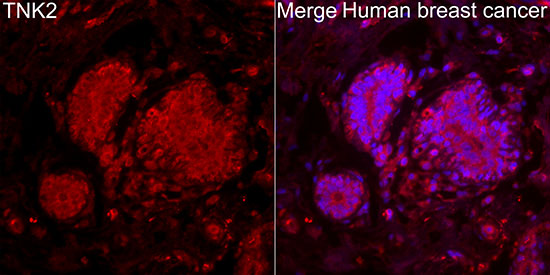
The antibody against TNK2 was raised in Rabbit using a synthetic peptide corresponding to a sequence within amino acids 939-1038 of human TNK2 (NP_005772.3?) as the immunogen. The polyclonal antibody exists as a isotype IgG, by affinity purification. This antibody has been validated on IF/ICC, ELISA.
| Cat.No | ADA-08475A | Clonality | Polyclonal |
|---|---|---|---|
| Host Species | Rabbit | Target Name | TNK2 |
| Target Synonyms | ACK; ACK1; ACK-1; p21cdc42Hs; TNK2 | Form | Liquid |
| Species Reactivity | Human, Mouse | Isotype | IgG |
| Storage Buffer | 50% Glycerol, PBS with 0.05% proclin300, pH7.3. | Purification Method | Affinity purification |
| Application | ELISA, IF/ICC |
| Immunogen Description | A synthetic peptide corresponding to a sequence within amino acids 939-1038 of human TNK2 (NP_005772.3?). | Target Species | Human |
|---|---|---|---|
| Immunogen Sequence | ATARLPQRGCPGDGPEAGRPADKIQMAMVHGVTTEECQAALQCHGWSVQRAAQYLKVEQLFGLGLRPRGECHKVLEMFDWNLEQAGCHLLGSWGPAHHKR | Uniprot ID | Q07912 |
Uniprot Id
Q07912
Target Species
Human
Target Name
TNK2
Target Full Name
Activated CDC42 kinase 1
Target Function
Non-receptor tyrosine-protein and serine/threonine-protein kinase that is implicated in cell spreading and migration, cell survival, cell growth and proliferation. Transduces extracellular signals to cytosolic and nuclear effectors. Phosphorylates AKT1, AR, MCF2, WASL and WWOX. Implicated in trafficking and clathrin-mediated endocytosis through binding to epidermal growth factor receptor (EGFR) and clathrin. Binds to both poly- and mono-ubiquitin and regulates ligand-induced degradation of EGFR, thereby contributing to the accumulation of EGFR at the limiting membrane of early endosomes. Downstream effector of CDC42 which mediates CDC42-dependent cell migration via phosphorylation of BCAR1. May be involved both in adult synaptic function and plasticity and in brain development. Activates AKT1 by phosphorylating it on 'Tyr-176'. Phosphorylates AR on 'Tyr-267' and 'Tyr-363' thereby promoting its recruitment to androgen-responsive enhancers (AREs). Phosphorylates WWOX on 'Tyr-287'. Phosphorylates MCF2, thereby enhancing its activity as a guanine nucleotide exchange factor (GEF) toward Rho family proteins. Contributes to the control of AXL receptor levels. Confers metastatic properties on cancer cells and promotes tumor growth by negatively regulating tumor suppressor such as WWOX and positively regulating pro-survival factors such as AKT1 and AR. Phosphorylates WASP.
Target Subcellular Location
Cell membrane. Nucleus. Endosome. Cell junction, adherens junction. Cytoplasmic vesicle membrane; Peripheral membrane protein; Cytoplasmic side. Cytoplasmic vesicle, clathrin-coated vesicle. Membrane, clathrin-coated pit. Cytoplasm, perinuclear region. Cytoplasm, cytosol.
Target Protein Families
Protein kinase superfamily, Tyr protein kinase family
Target Tissue Specificity
The Tyr-284 phosphorylated form shows a significant increase in expression in breast cancers during the progressive stages i.e. normal to hyperplasia (ADH), ductal carcinoma in situ (DCIS), invasive ductal carcinoma (IDC) and lymph node metastatic (LNMM)
Target Synonyms
ACK; ACK1; ACK-1; p21cdc42Hs; Phospho-TNK2-Y284
Target Background
This gene encodes a tyrosine kinase that binds Cdc42Hs in its GTP-bound form and inhibits both the intrinsic and GTPase-activating protein (GAP)-stimulated GTPase activity of Cdc42Hs. This binding is mediated by a unique sequence of 47 amino acids C-terminal to an SH3 domain. The protein may be involved in a regulatory mechanism that sustains the GTP-bound active form of Cdc42Hs and which is directly linked to a tyrosine phosphorylation signal transduction pathway. Several alternatively spliced transcript variants have been identified from this gene, but the full-length nature of only two transcript variants has been determined.
Notification