• Contact info@abtriva.com for inquiries and orders.
  • Chinese (Simplified)

  • English

  • German

  • Korean

  • Spanish

United States (English / $ USD)

Rabbit anti-Human TP53INP1 Polyclonal Antibody

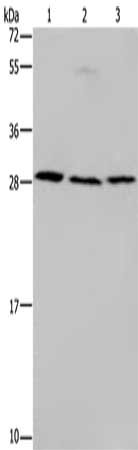
The antibody against TP53INP1 was raised in rabbit using the Synthetic peptide of Human TP53INP1 as the immunogen. This antibody exists as a non-conjugated isotype IgG, Antigen affinity purified. This antibody has been validated on ELISA, WB, IHC.

ADC-26218A

The antibody against TP53INP1 was raised in rabbit using the Synthetic peptide of Human TP53INP1 as the immunogen. This antibody exists as a non-conjugated isotype IgG, Antigen affinity purified. This antibody has been validated on ELISA, WB, IHC.

$299.00

Number
Order Exclusive Products Now

Request a Quote
High Purity LevelsPrecision and ReliabilityCustomization Options

Specifications


Cat.No ADC-26218A ClonalityPolyclonal
Host SpeciesRabbitTarget NameTP53INP1
FormLiquidSpecies ReactivityHuman
IsotypeIgGStorage Buffer0.05% NaN3, 40% Glycerol., pH7.4 PBS
Purification MethodAntigen affinity purifiedConjugateNon-conjugated
ApplicationELISA, IHC, WBStorageUpon receipt

Immunogen Information


Immunogen DescriptionSynthetic peptide of Human TP53INP1Target SpeciesHuman
Immunogen SequenceComplete sequences for the immunogen, target protein, and peptides are available upon request.Uniprot IDQ96A56
Background Information
  • Uniprot Id

    Q96A56

  • Target Species

    Human

  • Target Name

    TP53INP1

  • Target Full Name

    Tumor protein p53-inducible nuclear protein 1

  • Target Function

    Antiproliferative and proapoptotic protein involved in cell stress response which acts as a dual regulator of transcription and autophagy. Acts as a positive regulator of autophagy. In response to cellular stress or activation of autophagy, relocates to autophagosomes where it interacts with autophagosome-associated proteins GABARAP, GABARAPL1/L2, MAP1LC3A/B/C and regulates autophagy. Acts as an antioxidant and plays a major role in p53/TP53-driven oxidative stress response. Possesses both a p53/TP53-independent intracellular reactive oxygen species (ROS) regulatory function and a p53/TP53-dependent transcription regulatory function. Positively regulates p53/TP53 and p73/TP73 and stimulates their capacity to induce apoptosis and regulate cell cycle. In response to double-strand DNA breaks, promotes p53/TP53 phosphorylation on 'Ser-46' and subsequent apoptosis. Acts as a tumor suppressor by inducing cell death by an autophagy and caspase-dependent mechanism. Can reduce cell migration by regulating the expression of SPARC.

  • Target Subcellular Location

    Cytoplasm, cytosol. Nucleus. Nucleus, PML body. Cytoplasmic vesicle, autophagosome. Note=Shuttles between the nucleus and the cytoplasm, depending on cellular stress conditions, and re-localizes to autophagosomes on autophagy activation.

  • Target Tissue Specificity

    Ubiquitously expressed.

  • Target Synonyms

    DKFZp434M1317; FLJ22139; p53 damage inducible nuclear protein 1; p53 dependent damage inducible nuclear protein 1; p53 inducible nuclear protein 1; p53 inducible p53DINP1; p53-dependent damage-inducible nuclear protein 1; p53DINP1; SIP; Stress induced protein; Stress-induced protein; T53I1_HUMAN; Teap; TP53 DINP1; TP53 INP1; TP53DINP1; TP53INP1; TP53INP1A; TP53INP1B; Tumor protein p53 inducible nuclear protein 1; Tumor protein p53-inducible nuclear protein 1

  • Target Background

    Predicted to enable antioxidant activity. Involved in autophagic cell death; positive regulation of autophagy; and positive regulation of transcription, DNA-templated. Located in autophagosome; cytosol; and nucleus.

Inquire Rabbit anti-Human TP53INP1 Polyclonal Antibody Now


AbTriva respects your privacy and protects your personal data in accordance with AbTriva. For more information, please see our data protection statement. *

Notification