• Contact info@abtriva.com for inquiries and orders.
  • Chinese (Simplified)

  • English

  • German

  • Korean

  • Spanish

United States (English / $ USD)

Mouse anti-Human TUBB3 Monoclonal Antibody

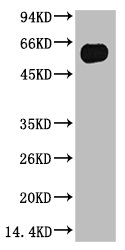
The antibody against TUBB3 was raised in mouse using the Recombinant Protein as the immunogen. This antibody exists as a non-conjugated isotype IgG. This antibody has been validated on ELISA, WB.

ADC-55668A

The antibody against TUBB3 was raised in mouse using the Recombinant Protein as the immunogen. This antibody exists as a non-conjugated isotype IgG. This antibody has been validated on ELISA, WB.

$167.00

Number
Order Exclusive Products Now

Request a Quote
High Purity LevelsPrecision and ReliabilityCustomization Options

Specifications


Cat.No ADC-55668A ClonalityMonoclonal
Host SpeciesMouseTarget NameTUBB3
FormLiquidSpecies ReactivityZebrafish
IsotypeIgGStorage BufferPH 7.4, containing 0.02% sodium azide as Preservative and 50% Glycerol., PBS
ConjugateNon-conjugatedApplicationELISA, WB
StorageUpon receipt

Immunogen Information


Immunogen DescriptionRecombinant ProteinTarget SpeciesHuman
Immunogen SequenceComplete sequences for the immunogen, target protein, and peptides are available upon request.Uniprot IDQ13509
Background Information
  • Uniprot Id

    Q13509

  • Target Species

    Human

  • Target Name

    TUBB3

  • Target Full Name

    Tubulin beta-3 chain

  • Target Function

    Tubulin is the major constituent of microtubules. It binds two moles of GTP, one at an exchangeable site on the beta chain and one at a non-exchangeable site on the alpha chain. TUBB3 plays a critical role in proper axon guidance and maintenance. Binding of NTN1/Netrin-1 to its receptor UNC5C might cause dissociation of UNC5C from polymerized TUBB3 in microtubules and thereby lead to increased microtubule dynamics and axon repulsion. Plays a role in dorsal root ganglion axon projection towards the spinal cord.

  • Target Involvement

    Fibrosis of extraocular muscles, congenital, 3A (CFEOM3A); Cortical dysplasia, complex, with other brain malformations 1 (CDCBM1)

  • Target Subcellular Location

    Cytoplasm, cytoskeleton. Cell projection, growth cone. Cell projection, lamellipodium. Cell projection, filopodium.

  • Target Protein Families

    Tubulin family

  • Target Tissue Specificity

    Expression is primarily restricted to central and peripheral nervous system. Greatly increased expression in most cancerous tissues.

  • Target Research Area

    Signal Transduction

  • Target Synonyms

    beta 3 tubulin; beta 4; beta-4; CDCBM; CDCBM1; CFEOM3; CFEOM3A; FEOM3; M(beta)3; M(beta)6; MC1R; Neuron specific beta III Tubulin; Neuron-specific class III beta-tubulin; QccE-11995; QccE-15186; TBB3_HUMAN; Tubb 3; TUBB3; TUBB4; Tubulin beta 3 ; Tubulin beta 3 chain; Tubulin beta 4 ; Tubulin beta III; Tubulin beta-3 chain; Tubulin beta-4 chain; Tubulin beta-III; tuj 1; tuj1

  • Target Background

    This gene encodes a class III member of the beta tubulin protein family. Beta tubulins are one of two core protein families (alpha and beta tubulins) that heterodimerize and assemble to form microtubules. This protein is primarily expressed in neurons and may be involved in neurogenesis and axon guidance and maintenance. Mutations in this gene are the cause of congenital fibrosis of the extraocular muscles type 3. Alternate splicing results in multiple transcript variants. A pseudogene of this gene is found on chromosome 6.

Inquire Mouse anti-Human TUBB3 Monoclonal Antibody Now


AbTriva respects your privacy and protects your personal data in accordance with AbTriva. For more information, please see our data protection statement. *

Notification