-
Chinese (Simplified)
-
English
-
German
-
Korean
-
Spanish
Chinese (Simplified)
English
German
Korean
Spanish
Sign up for an account to enjoy easy online shopping and instant order tracking.
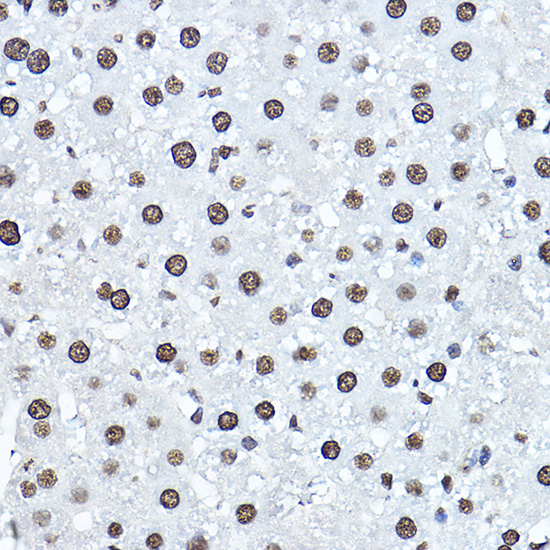
The antibody against Twist was raised in Rabbit using a synthetic peptide corresponding to a sequence within amino acids 51-150 of human Twist (NP_000465.1) as the immunogen. The polyclonal antibody exists as a isotype IgG, by affinity purification. This antibody has been validated on IHC-P, ELISA.
| Cat.No | ADA-00423A | Clonality | Polyclonal |
|---|---|---|---|
| Host Species | Rabbit | Target Name | Twist |
| Target Synonyms | CRS; CSO; SCS; ACS3; CRS1; BPES2; BPES3; SWCOS; TWIST; bHLHa38; Twist | Form | Liquid |
| Species Reactivity | Human, Mouse, Rat | Isotype | IgG |
| Storage Buffer | 50% Glycerol, PBS with 0.01% thimerosal, pH7.3. | Purification Method | Affinity purification |
| Positive Samples | HL-60 | Application | ELISA, IHC-P |
| Immunogen Description | A synthetic peptide corresponding to a sequence within amino acids 51-150 of human Twist (NP_000465.1). | Target Species | Human |
|---|---|---|---|
| Immunogen Sequence | GPGGAAGGGVGGGDEPGSPAQGKRGKKSAGCGGGGGAGGGGGSSSGGGSPQSYEELQTQRVMANVRERQRTQSLNEAFAALRKIIPTLPSDKLSKIQTLK | Uniprot ID | Q15672 |
Uniprot Id
Q15672
Target Species
Human
Target Name
TWIST1
Target Full Name
Twist-related protein 1
Target Function
Acts as a transcriptional regulator. Inhibits myogenesis by sequestrating E proteins, inhibiting trans-activation by MEF2, and inhibiting DNA-binding by MYOD1 through physical interaction. This interaction probably involves the basic domains of both proteins. Also represses expression of proinflammatory cytokines such as TNFA and IL1B. Regulates cranial suture patterning and fusion. Activates transcription as a heterodimer with E proteins. Regulates gene expression differentially, depending on dimer composition. Homodimers induce expression of FGFR2 and POSTN while heterodimers repress FGFR2 and POSTN expression and induce THBS1 expression. Heterodimerization is also required for osteoblast differentiation. Represses the activity of the circadian transcriptional activator: NPAS2-ARNTL/BMAL1 heterodimer.
Target Involvement
Saethre-Chotzen syndrome (SCS); Robinow-Sorauf syndrome (RSS); Craniosynostosis 1 (CRS1)
Target Subcellular Location
Nucleus.
Target Tissue Specificity
Subset of mesodermal cells.
Target Synonyms
ACS3; B-HLH DNA binding protein; bHLHa38; BPES2; BPES3; Class A basic helix-loop-helix protein 38; CRS; CRS1; CSO; H-twist; OTTHUMP00000116043; SCS; Twist basic helix loop helix transcription factor 1; Twist family bHLH transcription factor 1; Twist homolog 1 (Drosophila); Twist homolog 1; TWIST homolog of drosophila; Twist related protein 1; Twist-related protein 1; TWIST1; TWST1_HUMAN
Target Background
This gene encodes a basic helix-loop-helix (bHLH) transcription factor that plays an important role in embryonic development. The encoded protein forms both homodimers and heterodimers that bind to DNA E box sequences and regulate the transcription of genes involved in cranial suture closure during skull development. This protein may also regulate neural tube closure, limb development and brown fat metabolism. This gene is hypermethylated and overexpressed in multiple human cancers, and the encoded protein promotes tumor cell invasion and metastasis, as well as metastatic recurrence. Mutations in this gene cause Saethre-Chotzen syndrome in human patients, which is characterized by craniosynostosis, ptosis and hypertelorism.
Notification