-
Chinese (Simplified)
-
English
-
German
-
Korean
-
Spanish
Chinese (Simplified)
English
German
Korean
Spanish
Sign up for an account to enjoy easy online shopping and instant order tracking.
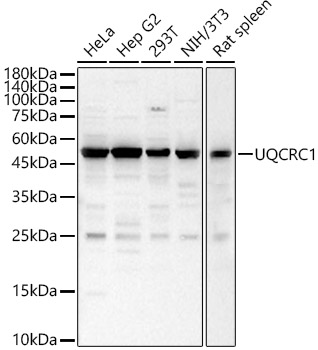
The antibody against UQCRC1 was raised in Rabbit using the recombinant fusion protein containing a sequence corresponding to amino acids 156-480 of human UQCRC1 (NP_003356.2) as the immunogen. The polyclonal antibody exists as a isotype IgG, by affinity purification. This antibody has been validated on WB, IHC-P, IF/ICC, ELISA.
| Cat.No | ADA-11249A | Clonality | Polyclonal |
|---|---|---|---|
| Host Species | Rabbit | Target Name | UQCRC1 |
| Target Synonyms | QCR1; PKNPY; UQCR1; D3S3191; UQCRC1 | Form | Liquid |
| Species Reactivity | Human, Mouse, Rat | Isotype | IgG |
| Storage Buffer | 50% Glycerol, PBS with 0.02% sodium azide, pH7.3. | Purification Method | Affinity purification |
| Positive Samples | HeLa, NIH/3T3, 293T, Hep G2, Rat spleen | Application | ELISA, WB, IF/ICC, IHC-P |
| Immunogen Description | Recombinant fusion protein containing a sequence corresponding to amino acids 156-480 of human UQCRC1 (NP_003356.2). | Target Species | Human |
|---|---|---|---|
| Uniprot ID | P31930 | Immunogen Sequence |
Uniprot Id
P31930
Target Species
Human
Target Name
UQCRC1
Target Full Name
Cytochrome b-c1 complex subunit 1, mitochondrial
Target Function
Component of the ubiquinol-cytochrome c oxidoreductase, a multisubunit transmembrane complex that is part of the mitochondrial electron transport chain which drives oxidative phosphorylation. The respiratory chain contains 3 multisubunit complexes succinate dehydrogenase (complex II, CII), ubiquinol-cytochrome c oxidoreductase (cytochrome b-c1 complex, complex III, CIII) and cytochrome c oxidase (complex IV, CIV), that cooperate to transfer electrons derived from NADH and succinate to molecular oxygen, creating an electrochemical gradient over the inner membrane that drives transmembrane transport and the ATP synthase. The cytochrome b-c1 complex catalyzes electron transfer from ubiquinol to cytochrome c, linking this redox reaction to translocation of protons across the mitochondrial inner membrane, with protons being carried across the membrane as hydrogens on the quinol. In the process called Q cycle, 2 protons are consumed from the matrix, 4 protons are released into the intermembrane space and 2 electrons are passed to cytochrome c. The 2 core subunits UQCRC1/QCR1 and UQCRC2/QCR2 are homologous to the 2 mitochondrial-processing peptidase (MPP) subunits beta-MPP and alpha-MPP respectively, and they seem to have preserved their MPP processing properties. May be involved in the in situ processing of UQCRFS1 into the mature Rieske protein and its mitochondrial targeting sequence (MTS)/subunit 9 when incorporated into complex III (Probable).
Target Subcellular Location
Mitochondrion inner membrane; Peripheral membrane protein; Matrix side.
Target Protein Families
Peptidase M16 family, UQCRC1/QCR1 subfamily
Target Synonyms
Complex III subunit 1; Core protein I; Cytochrome b-c1 complex subunit 1; cytochrome b-c1 complex subunit 1; mitochondrial; D3S3191; mitochondrial; OTTHUMP00000164820; QCR1; QCR1_HUMAN; Ubiquinol cytochrome c reductase complex core protein 1; ubiquinol-cytochrome c reductase core protein I; Ubiquinol-cytochrome-c reductase complex core protein 1; UQCR1; Uqcrc1
Target Background
Enables ubiquitin protein ligase binding activity. Predicted to be involved in oxidative phosphorylation. Predicted to act upstream of or within mitochondrial electron transport, ubiquinol to cytochrome c. Located in mitochondrion. Implicated in Alzheimer's disease. Biomarker of Alzheimer's disease.
Notification