-
Chinese (Simplified)
-
English
-
German
-
Korean
-
Spanish
Chinese (Simplified)
English
German
Korean
Spanish
Sign up for an account to enjoy easy online shopping and instant order tracking.
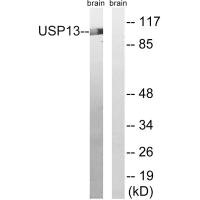
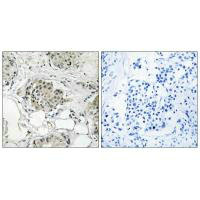
The antibody against USP13 was raised in rabbit using the Synthesized peptide derived from internal of Human USP13. as the immunogen. The antibody was affinity-purified from rabbit antiserum by affinity-chromatography using epitope-specific immunogen. This antibody has been validated on ELISA, WB, IHC.
$297.00
| Cat.No | ADC-40843A | Clonality | Polyclonal |
|---|---|---|---|
| Host Species | Rabbit | Target Name | USP13 |
| Form | Liquid | Species Reactivity | Human |
| Storage Buffer | PH 7.4, 0.02% sodium azide and 50% glycerol., 150mM NaCl, Rabbit IgG in phosphate buffered saline (without Mg2+ and Ca2+) | Purification Method | The antibody was affinity-purified from rabbit antiserum by affinity-chromatography using epitope-specific immunogen. |
| Application | ELISA, IHC, WB | Storage | Upon receipt |
| Immunogen Description | Synthesized peptide derived from internal of Human USP13. | Target Species | Human |
|---|---|---|---|
| Immunogen Sequence | Complete sequences for the immunogen, target protein, and peptides are available upon request. | Uniprot ID | Q92995 |
Uniprot Id
Q92995
Target Species
Human
Target Name
USP13
Target Full Name
Ubiquitin carboxyl-terminal hydrolase 13
Target Function
Deubiquitinase that mediates deubiquitination of target proteins such as BECN1, MITF, SKP2 and USP10 and is involved in various processes such as autophagy and endoplasmic reticulum-associated degradation (ERAD). Component of a regulatory loop that controls autophagy and p53/TP53 levels: mediates deubiquitination of BECN1, a key regulator of autophagy, leading to stabilize the PIK3C3/VPS34-containing complexes. Also deubiquitinates USP10, an essential regulator of p53/TP53 stability. In turn, PIK3C3/VPS34-containing complexes regulate USP13 stability, suggesting the existence of a regulatory system by which PIK3C3/VPS34-containing complexes regulate p53/TP53 protein levels via USP10 and USP13. Recruited by nuclear UFD1 and mediates deubiquitination of SKP2, thereby regulating endoplasmic reticulum-associated degradation (ERAD). Also regulates ERAD through the deubiquitination of UBL4A a component of the BAG6/BAT3 complex. Mediates stabilization of SIAH2 independently of deubiquitinase activity: binds ubiquitinated SIAH2 and acts by impairing SIAH2 autoubiquitination. Has a weak deubiquitinase activity in vitro and preferentially cleaves 'Lys-63'-linked polyubiquitin chains. In contrast to USP5, it is not able to mediate unanchored polyubiquitin disassembly. Able to cleave ISG15 in vitro; however, additional experiments are required to confirm such data.
Target Protein Families
Peptidase C19 family
Target Tissue Specificity
Highly expressed in ovary and testes.
Target Synonyms
Deubiquitinating enzyme 13; Isopeptidase T 3; Isopeptidase T-3; Isopeptidase T3; ISOT 3; ISOT-3; ISOT3; Ubiquitin carboxyl terminal hydrolase 13; Ubiquitin carboxyl-terminal hydrolase 13; Ubiquitin specific peptidase 13 (isopeptidase T3); Ubiquitin specific peptidase 13; Ubiquitin specific processing protease 13; Ubiquitin specific protease 13; Ubiquitin thioesterase 13; Ubiquitin thiolesterase 13; Ubiquitin-specific-processing protease 13; UBP13; UBP13_HUMAN; USP 13; USP13
Target Background
Enables several functions, including BAT3 complex binding activity; chaperone binding activity; and cysteine-type peptidase activity. Involved in several processes, including maintenance of unfolded protein involved in ERAD pathway; regulation of cellular catabolic process; and regulation of transcription, DNA-templated. Acts upstream of or within protein deubiquitination and protein stabilization. Predicted to be located in nucleoplasm. Predicted to be active in cytosol and nucleus.
Notification