-
Chinese (Simplified)
-
English
-
German
-
Korean
-
Spanish
Chinese (Simplified)
English
German
Korean
Spanish
Sign up for an account to enjoy easy online shopping and instant order tracking.
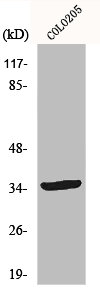
The antibody against YOD1 was raised in rabbit using the Synthesized peptide derived from the Internal region of Human OTUD2. as the immunogen. This antibody exists as a non-conjugated isotype IgG. The antibody was affinity-purified from rabbit antiserum by affinity-chromatography using epitope-specific immunogen. This antibody has been validated on WB, ELISA.
$167.00
| Cat.No | ADC-37956A | Clonality | Polyclonal |
|---|---|---|---|
| Host Species | Rabbit | Target Name | YOD1 |
| Form | Liquid | Species Reactivity | Human |
| Isotype | IgG | Storage Buffer | 0.5% BSA and 0.02% sodium azide., Liquid in PBS containing 50% glycerol |
| Purification Method | The antibody was affinity-purified from rabbit antiserum by affinity-chromatography using epitope-specific immunogen. | Conjugate | Non-conjugated |
| Application | ELISA, WB | Storage | Upon receipt |
| Immunogen Description | Synthesized peptide derived from the Internal region of Human OTUD2. | Target Species | Human |
|---|---|---|---|
| Immunogen Sequence | Complete sequences for the immunogen, target protein, and peptides are available upon request. | Uniprot ID | Q5VVQ6 |
Uniprot Id
Q5VVQ6
Target Species
Human
Target Name
YOD1
Target Full Name
Ubiquitin thioesterase OTU1
Target Function
Hydrolase that can remove conjugated ubiquitin from proteins and participates in endoplasmic reticulum-associated degradation (ERAD) for misfolded lumenal proteins. May act by triming the ubiquitin chain on the associated substrate to facilitate their threading through the VCP/p97 pore. Ubiquitin moieties on substrates may present a steric impediment to the threading process when the substrate is transferred to the VCP pore and threaded through VCP's axial channel. Mediates deubiquitination of 'Lys-27'-, 'Lys-29'- and 'Lys-33'-linked polyubiquitin chains. Also able to hydrolyze 'Lys-11'-linked ubiquitin chains. Cleaves both polyubiquitin and di-ubiquitin. May play a role in macroautophagy, regulating for instance the clearance of damaged lysosomes. May recruit PLAA, UBXN6 and VCP to damaged lysosome membranes decorated with K48-linked ubiquitin chains and remove these chains allowing autophagosome formation.
Target Subcellular Location
Cytoplasm.
Target Synonyms
DUBA-8; DUBA8; HIN-7; HIV-1-induced protease 7; HsHIN7; OTU domain containing 2; OTU domain-containing protein 2; OTU1_HUMAN; OTUD2; PRO0907; RP11-164O23.1; Ubiquitin thioesterase OTU1; yod1; YOD1 OTU deubiquinating enzyme 1 homolog (S. cerevisiae); YOD1 OTU deubiquinating enzyme 1 homolog (yeast); YOD1 OTU deubiquinating enzyme 1; S. cerevisiae; homolog of
Target Background
Protein ubiquitination controls many intracellular processes, including cell cycle progression, transcriptional activation, and signal transduction. This dynamic process, involving ubiquitin conjugating enzymes and deubiquitinating enzymes, adds and removes ubiquitin. Deubiquitinating enzymes are cysteine proteases that specifically cleave ubiquitin from ubiquitin-conjugated protein substrates. The protein encoded by this gene belongs to a DUB subfamily characterized by an ovarian tumor (OTU) domain. Alternative splicing results in multiple transcript variants.
Notification