-
Chinese (Simplified)
-
English
-
German
-
Korean
-
Spanish
Chinese (Simplified)
English
German
Korean
Spanish
Sign up for an account to enjoy easy online shopping and instant order tracking.
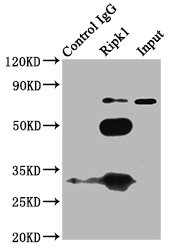
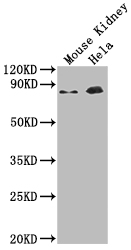
The antibody against Ripk1 was raised in rabbit using the Recombinant Mouse Receptor-interacting serine/threonine-protein kinase 1 protein (1-656AA) as the immunogen. This antibody exists as a non-conjugated isotype IgG, purified by protein G with a purity greater than 95%. This antibody has been validated on ELISA, WB, IP.
$299.00
| Cat.No | ADC-09965A | Clonality | Polyclonal |
|---|---|---|---|
| Host Species | Rabbit | Target Name | RIPK1 |
| Form | Liquid | Species Reactivity | Human, Mouse |
| Isotype | IgG | Storage Buffer | 0.01M PBS, 0.03% Proclin 300; Constituents: 50% Glycerol, PH 7.4 |
| Purification Method | >95%, Protein G purified | Conjugate | Non-conjugated |
| Application | ELISA, WB, IP | Storage | Upon receipt |
| Immunogen Description | Recombinant Mouse Receptor-interacting serine/threonine-protein kinase 1 protein (1-656AA) | Target Species | Mouse |
|---|---|---|---|
| Immunogen Sequence | Complete sequences for the immunogen, target protein, and peptides are available upon request. | Uniprot ID | Q60855 |
Uniprot Id
Q60855
Target Species
Mouse
Target Name
RIPK1
Target Full Name
Receptor-interacting serine/threonine-protein kinase 1
Target Function
Serine-threonine kinase which is a key regulator of TNF-mediated apoptosis, necroptosis and inflammatory pathways. Exhibits kinase activity-dependent functions that regulate cell death and kinase-independent scaffold functions regulating inflammatory signaling and cell survival. Has kinase-independent scaffold functions: upon binding of TNF to TNFR1, RIPK1 is recruited to the TNF-R1 signaling complex (TNF-RSC also known as complex I) where it acts as a scaffold protein promoting cell survival, in part, by activating the canonical NF-kappa-B pathway. Kinase activity is essential to regulate necroptosis and apoptosis, two parallel forms of cell death: upon activation of its protein kinase activity, regulates assembly of two death-inducing complexes, namely complex IIa (RIPK1-FADD-CASP8), which drives apoptosis, and the complex IIb (RIPK1-RIPK3-MLKL), which drives necroptosis. RIPK1 is required to limit CASP8-dependent TNFR1-induced apoptosis. In normal conditions, RIPK1 acts as an inhibitor of RIPK3-dependent necroptosis, a process mediated by RIPK3 component of complex IIb, which catalyzes phosphorylation of MLKL upon induction by ZBP1. Inhibits RIPK3-mediated necroptosis via FADD-mediated recruitment of CASP8, which cleaves RIPK1 and limits TNF-induced necroptosis. Required to inhibit apoptosis and necroptosis during embryonic development: acts by preventing the interaction of TRADD with FADD thereby limiting aberrant activation of CASP8. In addition to apoptosis and necroptosis, also involved in inflammatory response by promoting transcriptional production of pro-inflammatory cytokines, such as interleukin-6 (IL6). Phosphorylates RIPK3: RIPK1 and RIPK3 undergo reciprocal auto- and trans-phosphorylation. Phosphorylates DAB2IP at 'Ser-728' in a TNF-alpha-dependent manner, and thereby activates the MAP3K5-JNK apoptotic cascade. Required for ZBP1-induced NF-kappa-B activation in response to DNA damage.
Target Subcellular Location
Cytoplasm. Cell membrane.
Target Protein Families
Protein kinase superfamily, TKL Ser/Thr protein kinase family
Target Tissue Specificity
Found at low levels in all tissues.
Notification