• Contact info@abtriva.com for inquiries and orders.
  • Chinese (Simplified)

  • English

  • German

  • Korean

  • Spanish

United States (English / $ USD)

NTRK2 Recombinant Monoclonal Antibody

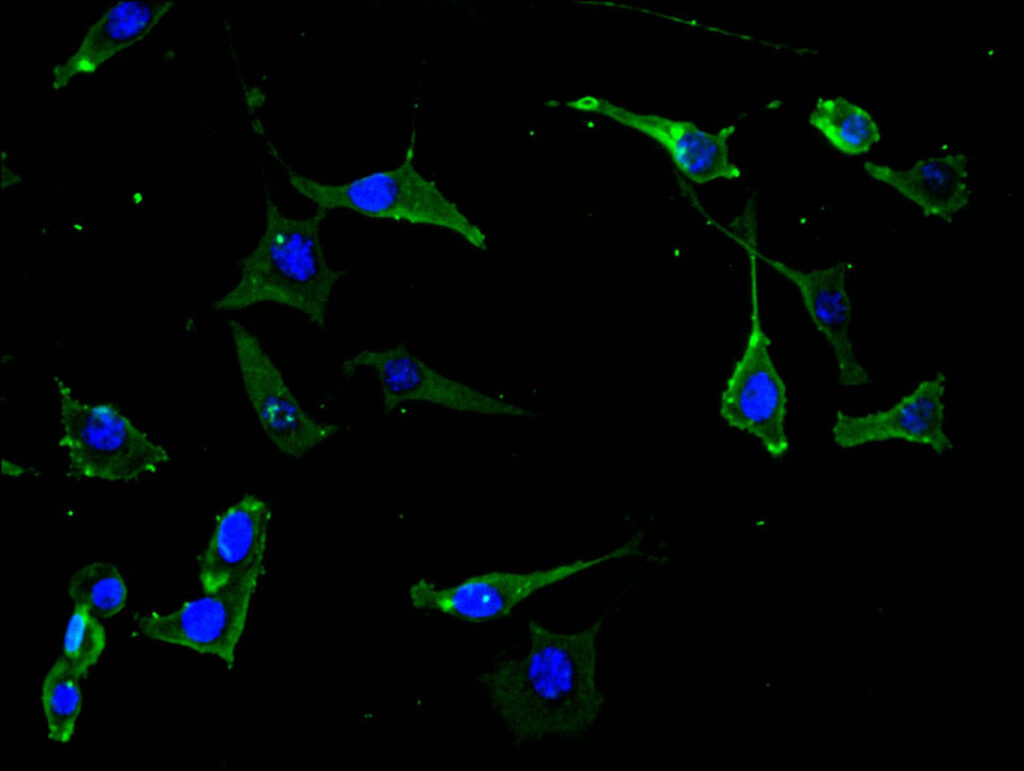
The recombinant antibody against NTRK2 was produced using the Recombinant Human NTRK2 protein as the immunogen. This antibody exists as a non-conjugated isotype Mouse IgG, Affinity-chromatography purified. This antibody has been validated on ELISA, IF.

ADC-56390A

The recombinant antibody against NTRK2 was produced using the Recombinant Human NTRK2 protein as the immunogen. This antibody exists as a non-conjugated isotype Mouse IgG, Affinity-chromatography purified. This antibody has been validated on ELISA, IF.

$350.00

Number
Order Exclusive Products Now

Request a Quote
High Purity LevelsPrecision and ReliabilityCustomization Options

Specifications


Cat.No ADC-56390A ClonalityMonoclonal
Target NameNTRK2Target Synonymsand developmental delay, hyperphagia
FormLiquidSpecies ReactivityHuman
IsotypeMouse IgGStorage Buffer0.01M PBS, 0.03% Proclin 300; Constituents: 50% Glycerol, PH 7.4
Purification MethodAffinity-chromatography purifiedConjugateNon-conjugated
ApplicationELISA, IFStorageUpon receipt

Immunogen Information


Immunogen DescriptionRecombinant Human NTRK2 proteinTarget SpeciesHuman
Immunogen SequenceComplete sequences for the immunogen, target protein, and peptides are available upon request.Uniprot IDQ16620
Background Information
  • Uniprot Id

    Q16620

  • Target Species

    Human

  • Target Name

    NTRK2

  • Target Full Name

    BDNF/NT-3 growth factors receptor

  • Target Function

    Receptor tyrosine kinase involved in the development and the maturation of the central and the peripheral nervous systems through regulation of neuron survival, proliferation, migration, differentiation, and synapse formation and plasticity. Receptor for BDNF/brain-derived neurotrophic factor and NTF4/neurotrophin-4. Alternatively can also bind NTF3/neurotrophin-3 which is less efficient in activating the receptor but regulates neuron survival through NTRK2. Upon ligand-binding, undergoes homodimerization, autophosphorylation and activation. Recruits, phosphorylates and/or activates several downstream effectors including SHC1, FRS2, SH2B1, SH2B2 and PLCG1 that regulate distinct overlapping signaling cascades. Through SHC1, FRS2, SH2B1, SH2B2 activates the GRB2-Ras-MAPK cascade that regulates for instance neuronal differentiation including neurite outgrowth. Through the same effectors controls the Ras-PI3 kinase-AKT1 signaling cascade that mainly regulates growth and survival. Through PLCG1 and the downstream protein kinase C-regulated pathways controls synaptic plasticity. Thereby, plays a role in learning and memory by regulating both short term synaptic function and long-term potentiation. PLCG1 also leads to NF-Kappa-B activation and the transcription of genes involved in cell survival. Hence, it is able to suppress anoikis, the apoptosis resulting from loss of cell-matrix interactions. May also play a role in neutrophin-dependent calcium signaling in glial cells and mediate communication between neurons and glia.

  • Target Involvement

    Obesity, hyperphagia, and developmental delay (OBHD)

  • Target Subcellular Location

    Cell membrane; Single-pass type I membrane protein. Endosome membrane; Single-pass type I membrane protein. Early endosome membrane. Cell projection, axon. Cell projection, dendrite. Cytoplasm, perinuclear region. Cell junction, synapse, postsynaptic density.

  • Target Protein Families

    Protein kinase superfamily, Tyr protein kinase family, Insulin receptor subfamily

  • Target Tissue Specificity

    Isoform TrkB is expressed in the central and peripheral nervous system. In the central nervous system (CNS), expression is observed in the cerebral cortex, hippocampus, thalamus, choroid plexus, granular layer of the cerebellum, brain stem, and spinal cor

  • Target Synonyms

    AI848316; BDNF tropomyosine receptor kinase B; BDNF/NT 3 growth factors receptor; BDNF/NT-3 growth factors receptor; Brain derived neurotrophic factor receptor; C030027L06Rik; EC 2.7.10.1; GP145 TrkB; GP145-TrkB; GP145-TrkB/GP95-TrkB; GP95 TrkB; Neurotrophic receptor tyrosine kinase 2; Neurotrophic tyrosine kinase receptor type 2; Neurotrophin receptor tyrosine kinase type 2; NTRK 2; Ntrk2; NTRK2_HUMAN; Obesity, hyperphagia, and developmental delay, included; RATTRKB1; Tkrb; Trk B; Trk-B; TRKB; TrkB tyrosine kinase; TRKB1; Tropomyosin related kinase B; tyrosine kinase receptor B; Tyrosine receptor kinase B

  • Target Background

    This gene encodes a member of the neurotrophic tyrosine receptor kinase (NTRK) family. This kinase is a membrane-bound receptor that, upon neurotrophin binding, phosphorylates itself and members of the MAPK pathway. Signalling through this kinase leads to cell differentiation. Mutations in this gene have been associated with obesity and mood disorders. Alternative splicing results in multiple transcript variants.

Inquire NTRK2 Recombinant Monoclonal Antibody Now


AbTriva respects your privacy and protects your personal data in accordance with AbTriva. For more information, please see our data protection statement. *

Notification