-
Chinese (Simplified)
-
English
-
German
-
Korean
-
Spanish

Chinese (Simplified)
English
German
Korean
Spanish
Sign up for an account to enjoy easy online shopping and instant order tracking.
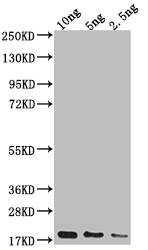
The antibody against Capsid protein was raised in rabbit using the Recombinant Escherichia phage Qbeta (Bacteriophage Q-beta) CAPSD protein as the immunogen. This antibody exists as a non-conjugated isotype IgG, Protein A/G purified. This antibody has been validated on ELISA, WB.
$299.00
| Cat.No | ADC-05269A | Clonality | Polyclonal |
|---|---|---|---|
| Host Species | Rabbit | Target Name | Capsid protein |
| Target Synonyms | Capsid protein antibody; CP antibody; Coat protein antibody | Form | Liquid |
| Species Reactivity | Escherichia phage Qbeta (Bacteriophage Q-beta) | Isotype | IgG |
| Storage Buffer | 0.01M PBS, 0.03% Proclin 300; Constituents: 50% Glycerol, PH 7.4 | Purification Method | Protein A/G purified |
| Conjugate | Non-conjugated | Application | ELISA, WB |
| Storage | Upon receipt |
| Immunogen Description | Recombinant Escherichia phage Qbeta (Bacteriophage Q-beta) CAPSD protein | Target Species | Escherichia phage Qbeta (Bacteriophage Q-beta) |
|---|---|---|---|
| Immunogen Sequence | Complete sequences for the immunogen, target protein, and peptides are available upon request. | Uniprot ID | P03615 |
Uniprot Id
P03615
Target Species
Escherichia phage Qbeta (Bacteriophage Q-beta)
Target Function
Capsid protein self-assembles to form an icosahedral capsid with a T=3 symmetry, about 26 nm in diameter, and consisting of 89 capsid proteins dimers (178 capsid proteins). Involved in viral genome encapsidation through the interaction between a capsid protein dimer and the multiple packaging signals present in the RNA genome. Binding of the capsid proteins to the viral RNA induces a conformational change required for efficient T=3 shell formation. The capsid contains also 1 copy of the A2 maturation protein.; Acts as a translational repressor of viral replicase synthesis late in infection. This latter function is the result of capsid protein interaction with an RNA hairpin which contains the replicase ribosome-binding site.
Target Subcellular Location
Virion.
Notification