-
Chinese (Simplified)
-
English
-
German
-
Korean
-
Spanish

Chinese (Simplified)
English
German
Korean
Spanish
Sign up for an account to enjoy easy online shopping and instant order tracking.
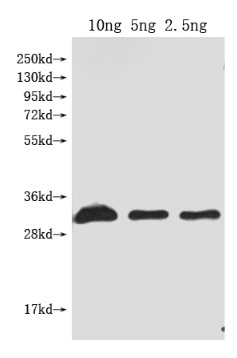
The antibody against Dop1R1 was raised in rabbit using the Recombinant Drosophila melanogaster (Fruit fly) Dop1R1 protein (20-142aa ) as the immunogen. This antibody exists as a non-conjugated isotype IgG, Protein G Purified. This antibody has been validated on ELISA, WB.
$299.00
| Cat.No | ADC-55400A | Clonality | Polyclonal |
|---|---|---|---|
| Host Species | Rabbit | Target Name | Dop1R1 |
| Target Synonyms | Dopamine receptor 1 (D-DOP1) (DmDop1) (dDA1) (Dopamine 1-like receptor 1) Dop1R1 DopR DopR1 DopR35EF CG9652 | Form | Liquid |
| Species Reactivity | Drosophila melanogaster (Fruit fly) | Isotype | IgG |
| Storage Buffer | 0.01M PBS, 0.03% Proclin 300; Constituents: 50% Glycerol, PH 7.4 | Purification Method | Protein G purified |
| Conjugate | Non-conjugated | Application | ELISA, WB |
| Storage | Upon receipt |
| Immunogen Description | Recombinant Drosophila melanogaster (Fruit fly) Dop1R1 protein (20-142aa ) | Target Species | Drosophila melanogaster (Fruit fly) |
|---|---|---|---|
| Immunogen Sequence | Complete sequences for the immunogen, target protein, and peptides are available upon request. | Uniprot ID | P41596 |
Uniprot Id
P41596
Target Species
Drosophila melanogaster
Target Name
DOP1R1
Target Function
Receptor for dopamine. The activity of this receptor is mediated by G proteins which activate adenylyl cyclase. Might be involved in the processing of visual information and/or visual learning. Important for Pavlovian conditioning: required in the mushroom body as a receptor conveying unconditional stimuli information, has a role in memory formation for aversive and appetitive learning. Sleep-deprivation-induced impairments in learning can be partially explained through alterations in dopamine signaling, Dop1R1 expression levels are reduced; sleep may have a role in restoring dopamine homeostasis.
Target Subcellular Location
Cell membrane; Multi-pass membrane protein.
Target Protein Families
G-protein coupled receptor 1 family
Target Tissue Specificity
Expressed in the larval and adult CNS in structures that mediate higher-order brain functions such as learning, memory and motor control: in the mushroom body neuropil and four unpaired neurons in each thoracic segment. The adult CNS has intense expressio
Notification