-
Chinese (Simplified)
-
English
-
German
-
Korean
-
Spanish

Chinese (Simplified)
English
German
Korean
Spanish
Sign up for an account to enjoy easy online shopping and instant order tracking.
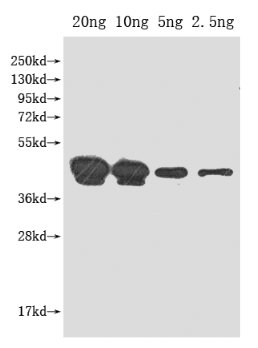
The antibody against pho was raised in rabbit using the Recombinant Drosophila melanogaster (Fruit fly) pho protein (1-250aa ) as the immunogen. This antibody exists as a non-conjugated isotype IgG, Protein G Purified. This antibody has been validated on ELISA, WB.
$299.00
| Cat.No | ADC-55386A | Clonality | Polyclonal |
|---|---|---|---|
| Host Species | Rabbit | Target Name | pho |
| Target Synonyms | Polycomb protein PHO (Protein pleiohomeotic) (Transcription factor YY1 homolog) pho CG17743 | Form | Liquid |
| Species Reactivity | Drosophila melanogaster (Fruit fly) | Isotype | IgG |
| Storage Buffer | 0.01M PBS, 0.03% Proclin 300; Constituents: 50% Glycerol, PH 7.4 | Purification Method | Protein G purified |
| Conjugate | Non-conjugated | Application | ELISA, WB |
| Storage | Upon receipt |
| Immunogen Description | Recombinant Drosophila melanogaster (Fruit fly) pho protein (1-250aa ) | Target Species | Drosophila melanogaster (Fruit fly) |
|---|---|---|---|
| Immunogen Sequence | Complete sequences for the immunogen, target protein, and peptides are available upon request. | Uniprot ID | Q8ST83 |
Uniprot Id
Q8ST83
Target Species
Drosophila melanogaster
Target Name
PHO
Target Function
Polycomb group (PcG) protein that binds to the 5'-CNGCCATNNNNG-3' sequence found in the regulatory regions of many genes. PcG proteins act by forming multiprotein complexes, which are required to maintain the transcriptionally repressive state of homeotic genes throughout development. PcG proteins are not required to initiate repression, but to maintain it during later stages of development. They probably act via the methylation of histones, rendering chromatin heritably changed in its expressibility. Probably targets the Esc/E(z) complex to DNA. Necessary but not sufficient to recruit a functional PcG repressive complex that represses target genes, suggesting that the recruitment of the distinct PRC1 complex is also required to allow a subsequent repression.; Proposed core component of the chromatin remodeling Ino80 complex which is involved in transcriptional regulation, DNA replication and probably DNA repair.
Target Subcellular Location
Nucleus.
Notification