-
Chinese (Simplified)
-
English
-
German
-
Korean
-
Spanish

Chinese (Simplified)
English
German
Korean
Spanish
Sign up for an account to enjoy easy online shopping and instant order tracking.
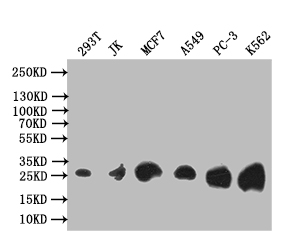
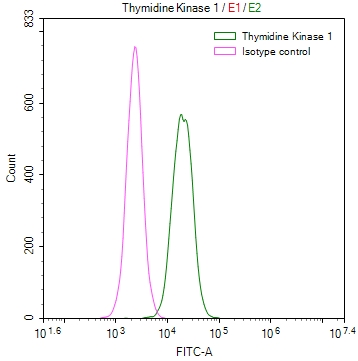
The recombinant antibody against TK1 was produced using a synthesized peptide derived from Human TK1 as the immunogen. This antibody exists as a non-conjugated isotype Rabbit IgG, Affinity-chromatography purified. This antibody has been validated on ELISA, WB, IF, FC.
$350.00
| Cat.No | ADC-56584A | Clonality | Monoclonal |
|---|---|---|---|
| Target Name | TK1 | Target Synonyms | cytosolic (EC 2.7.1.21), Thymidine kinase, TK1 |
| Form | Liquid | Species Reactivity | Human |
| Isotype | Rabbit IgG | Storage Buffer | PH 7.4, 0.02% sodium azide and 50% glycerol., 150mM NaCl, Rabbit IgG in phosphate buffered saline |
| Purification Method | Affinity-chromatography purified | Conjugate | Non-conjugated |
| Application | ELISA, IF, WB, FC | Storage | Upon receipt |
| Immunogen Description | A synthesized peptide derived from Human TK1 | Target Species | Human |
|---|---|---|---|
| Immunogen Sequence | Complete sequences for the immunogen, target protein, and peptides are available upon request. | Uniprot ID | P04183 |
Uniprot Id
P04183
Target Species
Human
Target Name
TK1
Target Full Name
Thymidine kinase, cytosolic
Target Subcellular Location
Cytoplasm.
Target Protein Families
Thymidine kinase family
Target Synonyms
TK2; Thymidine Kinase 1
Target Background
The protein encoded by this gene is a cytosolic enzyme that catalyzes the addition of a gamma-phosphate group to thymidine. This creates dTMP and is the first step in the biosynthesis of dTTP, which is one component required for DNA replication. The encoded protein, whose levels fluctuate depending on the cell cycle stage, can act as a low activity dimer or a high activity tetramer. High levels of this protein have been used as a biomarker for diagnosing and categorizing many types of cancers.
Notification